

Application
A hook-and-loop patch is a two-part fastening, not a patch with a sticky back. One half lives on the patch and the other has to be attached to the garment — and almost everything that goes wrong with them comes from getting that second half wrong.
Short answer. The patch carries the hook side: stiff, moulded, plastic-feeling. The garment carries the loop side: soft, fuzzy, cloth-like. The loop panel is stitched to the garment through all four sides. Once it is on, patches swap in seconds.
What is a Velcro patch?
A Velcro patch is simply a hook-and-loop patch: a patch with the stiff hook half of a hook-and-loop fastener on its back, so it presses onto a soft loop panel and pulls off again. “Velcro” is a brand name that has become the everyday word for it. They are used on tactical gear, caps, backpacks, work jackets and uniforms where patches need to swap — name tapes, flags, unit insignia and morale patches. We make them to order as custom Velcro patches.
The two halves, and which is which
Hook-and-loop fastening is two different materials that only work as a pair. The hook face is a field of small stiff plastic hooks, moulded rather than woven, and it feels rough and slightly sharp against your palm. The loop face is a soft pile of tiny fabric loops. Press them together and the hooks catch in the loops; peel them apart and they release with the tearing noise everyone recognises.
The convention across the whole trade is that the patch carries hook and the garment carries loop. There is a practical reason for it. Exposed hook on a garment snags jumpers, catches lint and abrades whatever it touches in a wash. Exposed loop is soft, quiet and does none of that, so the half left showing when the patch is off is the harmless one.
If you have ever seen “hook fastener patch” or “hook backing” on a supplier’s order form, that is what it means: the patch is supplied with the hook half already attached to its back. Some suppliers list this as “velcro backing”, which is a brand name being used generically — Velcro is a trademark for one manufacturer’s hook-and-loop products, not the name of the fastening.
If you are ordering rather than retrofitting, ask for it as hook backing by name — we list it that way — because “velcro backing” means different things to different makers.
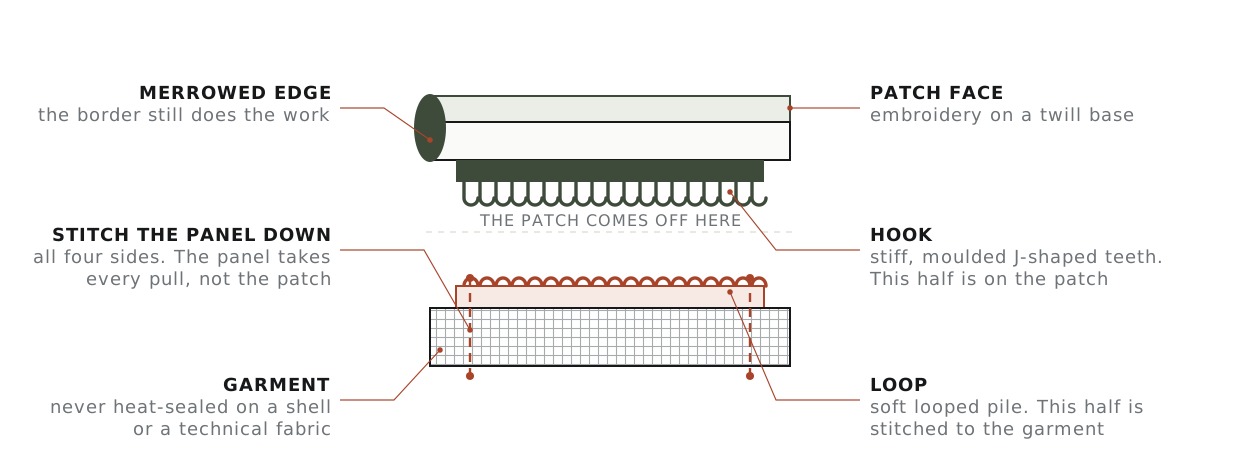
The loop panel does all the work
Every time the patch is pulled off, the entire force goes into the loop panel and whatever is holding it to the garment. The patch itself takes almost none of it. This is the single most useful thing to understand about the system, because it tells you where to spend your effort.
Stitch the panel down through all four sides, close to its edge, with a thread that matches the garment rather than the panel. Do not glue it, and do not rely on a peel-and-stick backing on a panel that will be pulled monthly — adhesive holds fine until the first hot wash, and then it lifts at a corner and the corner becomes a flap that catches on everything.
On a thin or stretchy garment, put a piece of light woven interfacing behind the panel before stitching. Without it, the panel is stiffer than the fabric around it and the stitch line becomes a tear line at the corners.
How to add Velcro to a patch that does not have it
Plenty of patches arrive with a plain or iron-on back and you want them swappable. The job is straightforward, with one thing to get right.
- Buy self-adhesive hook tape and cut it slightly smaller than the patch — about 3 mm inside the border all the way round. Hook that reaches the edge will show from the front and catch on the garment as you position it.
- Round the corners of the cut piece. Square corners are where peeling starts.
- Peel and press it onto the back of the patch, then leave it under a weight for an hour. The adhesive is a positioning aid.
- Stitch it. Run a line around the perimeter of the hook tape, through the patch base. On a merrowed patch, hide the stitching just inside the bead. This is the step people skip and the reason hook tape falls off patches.
- If the patch has heat-seal film on the back already, press the hook tape on top of it rather than trying to remove the film. Removing it usually takes the base cloth with it.
Sewing hook tape is hard on a domestic machine — the plastic drags under a standard foot and blunts needles quickly. Use a Teflon or walking foot, a size 90/14 needle, and go slowly. By hand, a curved needle and a thimble is genuinely easier than fighting a machine.
What goes wrong
| Symptom | Cause | What to do |
|---|---|---|
| Patch falls off in normal wear | Hook tape is smaller than it should be, or the loop panel is worn | Cover at least 70% of the patch back with hook; replace a panel whose pile has flattened |
| Grip fades over a few months | Hook is clogged with lint, pet hair or fleece pills | Brush the hook out with a stiff nail brush or pick it clean; it recovers almost fully |
| Patch edges curl away from the garment | Hook tape stops well short of the patch edge | Add a second, smaller piece near the corners, or stitch the patch edge down at two points |
| Everything else in the wash is covered in fluff | Exposed hook went through the drum | Close the patch onto its panel, or cover the panel, before washing |
| Panel corners lifting on a shell jacket | Panel was glued or heat-sealed to a technical fabric | Stitch it — and see the fabric warning below |
Fabrics that rule it out
Hook-and-loop is one of the few attachment methods that works on almost anything, because the panel is stitched rather than heat-bonded. There are still two cases to think about before you cut anything.
- Waterproof shells and technical fabrics. Stitching a panel puts a line of needle holes through the waterproof layer. On a serious rain shell that matters; either accept it, seam-seal the inside afterwards, or attach the panel to a placket or pocket flap that is already double-layered.
- Fleece, knitwear and anything with a pile. The loop half works, but the hook half will pick up the garment’s own fibres every time the patch comes off. Expect to clean the hook more often here than anywhere else.
Never heat-seal either half onto nylon, polyester shell fabric or anything waterproof. The face fabric glazes or melts well below the temperature the adhesive needs, and on a coated fabric the coating is destroyed even when the outside looks fine. This is covered in more detail in the application guide.
When to use something else
Hook-and-loop earns its place when the patch genuinely needs to change — interchangeable unit or team identifiers, patches that come off for an inspection, a jacket that carries different badges for different events, or a child’s garment where the badge outlasts the fit.
When the patch is going on once and staying there, it is the wrong choice. It adds bulk, it adds a rigid panel to a garment that did not need one, and it gives you a patch that can be lost. Sew it on instead — the application guide covers the stitch line, and patch types covers which backing suits which garment.
Sizes
Hook and loop tape is sold by width in inches, most commonly 1, 2, 3 and 4 in, and by the metre or foot. For patch work, buy tape wider than you need and cut it down; buying the exact width means every patch has to match the tape rather than the other way round.
For the panel, cut it about 3 mm larger than the patch on every side so no hook overhangs the loop. See patch sizes for how patch dimensions are quoted — it is not what most people assume.
What kind of patches stick to velcro?
Any patch with a hook backing will stick to velcro loop fabric. A hook patch, also called a hook backing patch, has the rough hook side of the hook and loop fastener sewn to the back. It attaches to the soft loop panels found on tactical gear, uniforms and many backpacks. A patch with a plain fabric back will not stick to velcro until hook tape is added.
Hook and loop: the two halves, and which is which
| Hook | Loop | |
|---|---|---|
| Feels like | Stiff and scratchy; catches a fingertip | Soft and fuzzy, like felt |
| Under a loupe | Thousands of tiny plastic J-shaped hooks | A dense mat of fine nylon loops |
| Goes on | The back of the patch | The garment or gear |
| Also called | Hook backing, the rough side, the male side | Loop panel, the soft side, the female side |
The hooks bend, catch in the loops and hold under shear load — which is why a patch resists being slid sideways far better than being peeled. Peel it from a corner and it comes away easily. That asymmetry is by design.
So: the patch gets the hook, the garment gets the loop. If someone sends you “velcro for patches” without saying which half, ask. A box of loop when you needed hook is a week lost.
Is a Velcro patch the same as a hook-and-loop patch?
Yes. Velcro is a brand — the company that invented the fastener in the 1950s and still makes it — and hook-and-loop is the generic description. Military and industrial specifications say hook-and-loop because a spec cannot name a brand. Everyone else says Velcro. They describe the same thing, and on a patch spec sheet “hook backing” and “Velcro backing” mean exactly the same product.
What a hook backing patch is used for
- Uniforms. The badge outlives the shirt and comes off before the wash. This is why hook backing took over military and tactical uniforms almost completely.
- Plate carriers and chest rigs. Loop panels are built into the front and the admin flap. Flags, callsigns, blood types and unit markings swap by task.
- Morale patches. The entire category exists because the patch is temporary by nature — see custom morale patches.
- Bags and packs. A loop square on the front of a pack turns it into a board. Patches for backpacks covers panel sizes.
- Workwear with changing staff. One jacket, a new name patch each time somebody new wears it — Velcro name patches.
A velcro logo patch: what the backing does to your design
Hook backing stiffens the patch and adds about a millimetre of thickness. Two consequences worth knowing before you draw anything. First, the patch stops flexing with the garment, so fine lettering stays flat and legible instead of distorting across a chest or a sleeve — small type behaves better on a hook-backed patch than on a sewn one. Second, the edge sits proud, so a merrowed border looks deliberate and a hot-cut edge can look unfinished. Most hook-backed patches are better with a merrowed or laser-cut edge.
Embroidered and PVC both take hook equally well. PVC wins outdoors; embroidery wins on texture. The side-by-side is on printed and PVC patches on hook backing.
Custom velcro fasteners: getting the loop panel right
If your gear already has loop — most tactical jackets, carriers and operator caps do — you only need the patch. If it does not, order the loop panel with the patches and sew it on. Two rules:
- Cut the loop larger than the patch, about 6 mm per side, so no hook edge overhangs. An overhanging hook edge catches on everything and peels itself off.
- Sew the loop, do not glue or iron it. Adhesive loop panels lift at the corners within weeks on anything load-bearing. The step-by-step is on sewing a Velcro panel on.
Will it survive a wash?
Take the patch off first. Left attached through a machine cycle, the hook collects lint and fibre and loses grip — not immediately, but measurably over a few washes. A stiff brush or a comb pulls the fuzz out and most of the grip comes back. The loop panel sewn to the garment washes fine and is best closed against itself or covered so it does not act as a lint trap.
More common questions
Which half goes on the patch?
The hook, always. It is the stiff one.
Can I add hook backing to a patch I already own?
Yes, by hand in about ten minutes. See adding Velcro to an existing patch.
Does hook backing cost more?
No. Hook backing is one of the included backing choices on an order here, alongside sew-on, iron-on and peel-n-stick. Custom Velcro patches start from $0.75 a piece at volume.
Can a Velcro patch also be sewn down?
Yes, and people do it on patches that must not be lost — the hook lets it be removed for laundering, a few stitches at the corners stop it walking off in the field. You lose the fast swap.
How long does hook backing last?
Thousands of cycles in clean conditions. What kills it is lint, sand and dog hair, not use.
Common questions
Is a hook-and-loop patch the same as a velcro patch?
The trade term is hook-and-loop. Some suppliers list it as “velcro backing”, which is ambiguous on its own — ask for hook backing by name so you know which half you are getting.
Which half goes on the patch?
The patch carries the hook side: stiff, moulded and plastic-feeling. The garment carries the loop side: a soft pile of tiny fabric loops. That is the convention across the whole trade.
Can I glue the loop panel on instead of sewing it?
No. Stitch it to the garment through all four sides. Adhesive holds fine until the first hot wash, then it lifts at a corner, and the corner becomes a flap that catches on everything.
How much bigger should the loop panel be than the patch?
Cut the panel about 3 mm larger than the patch on every side, so that no hook overhangs the loop.
Can I put a loop panel on a thin or stretchy garment?
Yes, but put a piece of light woven interfacing behind the panel before stitching. Without it the panel is stiffer than the fabric around it and the stitch line becomes a tear line at the corners.
Have these made
Need patches made?
We make embroidered, chenille, woven, leather and PVC patches to order — from $0.75 a patch, with a free digital proof before production and any backing you need.