
Specification
Patch size is quoted in a way that surprises most people the first time: not by area, and not by the longest edge, but by the average of height and width. Two quotes for “a 4 inch patch” can describe quite different objects.
Short answer. Most suppliers price a patch on (height + width) ÷ 2. A 3 in × 5 in patch is therefore a “4 inch” patch. For placement, 3 in is the default left chest size, 2 in suits a cap front or sleeve, and 4–5 in is jacket-back territory.
How suppliers measure a patch
The convention across most of the trade is to average the two dimensions. It is not an attempt to confuse anyone — it exists because stitch count, which is what actually drives cost, tracks the average dimension more closely than it tracks either edge on its own.
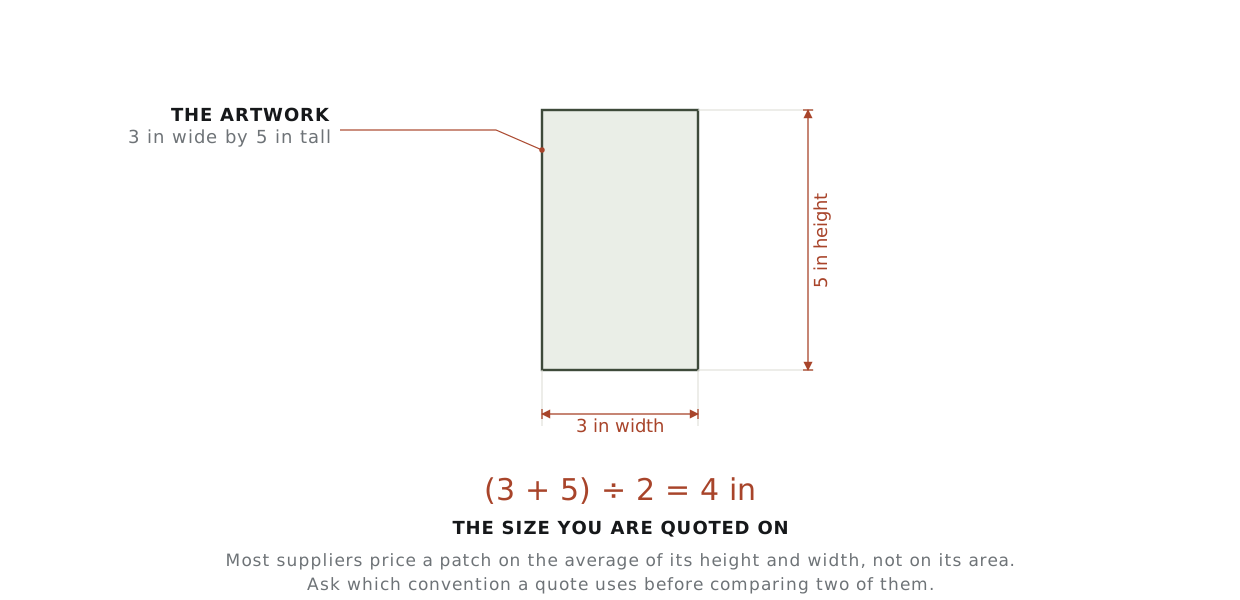
Two consequences worth holding on to. First, a long thin patch — a name tape, a rocker, a banner — is quoted much smaller than its length suggests, which is why name tapes are cheap. Second, when you compare two suppliers, check that both are averaging. Some quote the longest edge, and a “4 inch” patch under that convention is a noticeably bigger object.
Ask the question directly: is that four inches averaged, or four inches on the long side? It takes one line in an email and it is the difference between comparable quotes and a false saving.
Not every supplier quotes this way, so ask before you assume. We quote on the same average-of-two-sides basis described above.
Standard sizes and what each one is for
| Size | Typical placement | What fits in it | Notes |
|---|---|---|---|
| 1.5–2 in | Cap front, sleeve, name tape | A simple mark, initials, or one short word | Below about 2 in, drop any text under 1/4 in tall |
| 2.5–3 in | Left chest | A logo plus one line of readable text | The default. If in doubt, this is the size |
| 3.5–4 in | Jacket pocket, bag panel, cap back | A logo with a word above and below | Comfortable for a two-colour design with an outline |
| 4–5 in | Vest panel, small back patch | Full artwork with fine detail | Stiff enough to need a flat panel to sit on |
| 8–12 in | Jacket back, full back | Anything | Ask about a split or a two-piece top rocker |
These are conventions rather than rules, and they scale with the garment. On a youth garment take a size down; on a 2XL work jacket the left chest can carry 3.5 in without looking small. Placement guides covers where each of these actually sits and how the drop is measured.
Size sets the detail limit, not the other way round
The most common ordering mistake is choosing a size first and then being told the artwork has to change. It is worth knowing the limits before you commit.
- Embroidered text needs about 1/4 in (6 mm) of cap height to stay legible, and closer to 5/16 in for a serif face or anything with thin strokes. Below that the letters fill in and read as a smudge.
- Line weight. A satin-stitched line thinner than about 1 mm will not hold. If your logo has a hairline rule or a fine outline, it either thickens or it disappears.
- Gaps between elements need to be at least as wide as the lines around them, or the thread closes them up.
- Gradients and photographic detail do not exist in embroidery. If the artwork depends on them, the answer is a woven or printed patch rather than a bigger embroidered one.
If the design will not survive at the size the placement demands, the fix is usually a different construction rather than a bigger patch. Patch types compared covers where woven and printed win.
Size and price
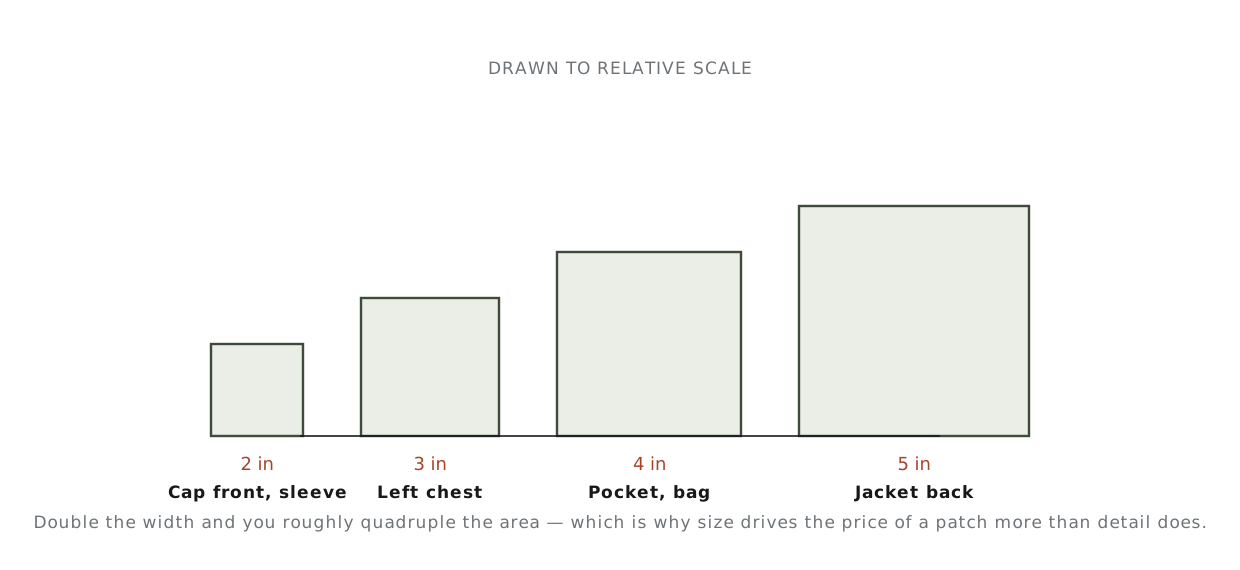
Price follows stitch count, and stitch count follows area. Doubling the quoted size roughly quadruples the area, so a 4 in patch is not twice the price of a 2 in patch — it is closer to four times, before any minimum-order effects.
Two levers pull the price down without changing the finished look. Reduce thread coverage so the twill base carries a background colour instead of being stitched over — that alone can halve a stitch count. And simplify the outline: a shape that a merrow machine can follow is cheaper to finish than one that needs hot-cutting. Both are covered in patch types.
Measuring for a placement you already have
- Lay the garment flat and square, and mark the placement from a seam — the high point of shoulder, the collar seam, the brim seam on a cap. Never from a hem.
- Cut a rectangle of paper to the size you are considering and pin it in place.
- Look at it on a body or a form, from about two metres. Patches that measure correctly can still read as too large; this is the only step that catches it.
- Check clearance: on a cap, the patch must not bridge the centre seam or run past the front panel. On a placket, it must not straddle the opening.
- Then convert to the quoting convention — average the two dimensions — before you ask for a price.
If a supplier will not tell you their minimum text height or their smallest reliable line weight, that is worth more than a price difference. Those two numbers are how you tell a digitiser who tests their work from one who does not.
Related: where each size normally sits, how construction changes what a size can carry, and how to attach it once it arrives.
Common questions
How big is a 4 inch patch?
A 4 inch patch is not four inches on any single edge. Suppliers quote the average of height and width, so a 3 in × 5 in patch is a “4 inch” patch. Two quotes for the same nominal size can describe quite different objects.
What size patch should I use for a left chest?
3 in is the default left chest size. On a 2XL work jacket the left chest can carry 3.5 in without looking small, and on a youth garment take a size down.
What is the smallest text that will embroider cleanly?
About 1/4 in (6 mm) of cap height, and closer to 5/16 in for a serif face or anything with thin strokes. Below that the letters fill in and read as a smudge.
Why does the supplier’s size not match mine?
The same patch is “3 by 5” to you and “4 inch” to the supplier. The average is used because stitch count, which is what drives cost, tracks the average dimension more closely than it tracks either edge on its own.
How big should a jacket back patch be?
8–12 in is jacket-back territory. 4–5 in suits a vest panel or a small back patch. Above that, ask about a split or a two-piece top rocker.
Have these made
Need patches made?
We make embroidered, chenille, woven, leather and PVC patches to order — from $0.75 a patch, with a free digital proof before production and any backing you need.