
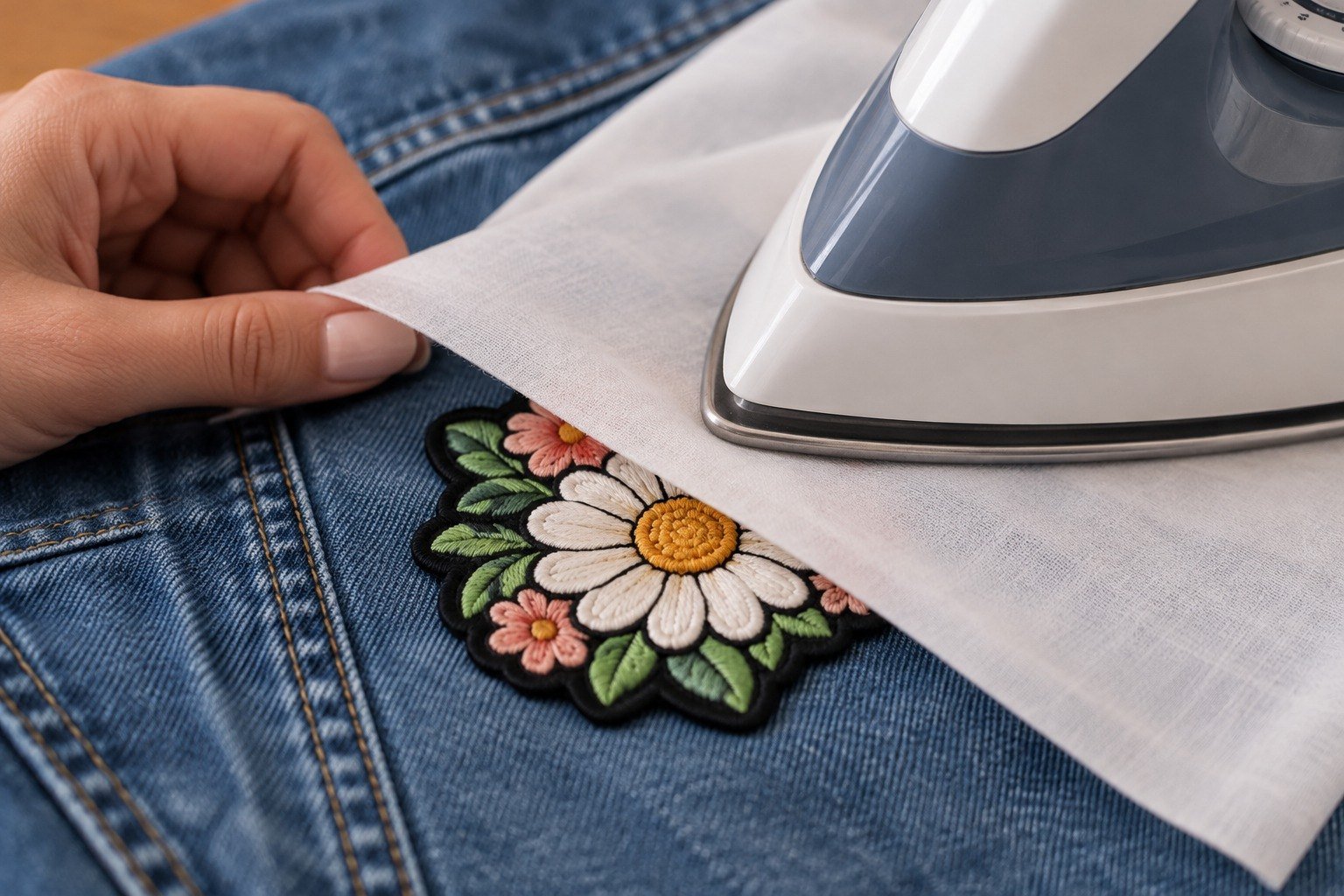
Iron-on patches
On custom iron-on patches, the iron-on is a heat-seal film laid on the back of the finished patch. It is not glue, and it is not a shortcut. It bonds properly to cotton and cotton-rich cloth under real heat and pressure, and it fails on almost everything else — which is worth knowing before you order five hundred.
| Price | From $0.75 per piece — full grid on patch pricing |
| Minimum order | 50 pieces |
| Production | 10–12 business days standard, 5–7 rush at no extra charge |
| Shipping | Free and tracked worldwide, usually 3–7 business days in transit |
| Proof | Free digital proof — nothing is made until you approve it |
| Payment | 50% deposit once the proof is approved, 50% before dispatch |
How the backing works
A thin thermoplastic film is fused to the back of the patch during finishing. Under heat it melts, flows into the weave of the garment, and sets as it cools. The bond is mechanical, not chemical — the adhesive has to physically key into the fibres, which is why it needs a flat, absorbent, heat-tolerant cloth to work on.
Three things have to be right at once: temperature, pressure and dwell time. A heat press holds all three. A household iron holds none of them reliably, which is why so many iron-on patches lift at the corners after a wash or two. We will say so on your quote rather than let you find out later.
How much do custom iron-on patches cost?
Iron-on is a standard backing, not an upgrade. An embroidered patch with a heat-seal back costs the same as the same patch with a plain sew-on back — from $0.75 a piece. Size is measured as the average of height and width, so a 3 by 5 inch patch is quoted as a 4 inch patch.
| Size | 50 pcs | 100 pcs | 300 pcs | 500 pcs | 1000 pcs |
|---|---|---|---|---|---|
| 2 inch | $2.95 | $1.85 | $1.10 | $0.95 | $0.75 |
| 2.5 inch | $3.45 | $2.15 | $1.35 | $1.15 | $0.90 |
| 3 inch | $3.95 | $2.55 | $1.60 | $1.35 | $1.05 |
| 3.5 inch | $4.65 | $2.95 | $1.90 | $1.60 | $1.25 |
| 4 inch | $5.35 | $3.45 | $2.25 | $1.90 | $1.55 |
| 4.5 inch | $6.15 | $3.95 | $2.65 | $2.25 | $1.85 |
Woven, PVC and leather faces can carry a heat-seal back too, at those constructions’ own rates. Full coverage embroidery adds 15%, as it does on any patch.
Which fabrics take it
This is the part that decides whether iron-on is the right order. Tell us the garment at quote stage and we will back the patches to suit it.
| Fabric | Heat-seal? | What we do instead |
|---|---|---|
| Cotton, denim, canvas, twill, poplin | Yes | The category iron-on was made for. We still suggest stitching if it will be washed weekly |
| Cotton/poly blends | Usually | Lower end of the temperature range, and test one first. The polyester content is what glazes |
| Nylon | No | Melts below the temperature the adhesive needs. Sew-on, or a hook-and-loop panel |
| Polyester shells, waterproofs | No | The inner coating is destroyed and the garment leaks. Sew-on only |
| Leather, suede, waxed cotton | No | Heat marks hide permanently and wax melts out. Stitched, or a leather patch instead |
| Fleece, terry, knitwear | No | Pile gives the adhesive nothing flat to grip, and pressing crushes it. Sew-on |
| Performance and stretch knits | No | The cloth moves and the patch does not, so corners tear. Sew-on |
| Flame-resistant and high-visibility | No | Modifying these can void the garment’s certification. Ask the garment maker first |
Applying them
If you are applying in-house, a heat press is the only equipment that does this properly: it holds an even temperature across the whole face and applies real pressure for a measured time. A domestic iron can work on small patches on heavy cotton if you are patient and press rather than slide, but it is not a production method.
For anything that will be worn hard or washed often, the honest answer is to iron the patch on to position it and then stitch the edge. Heat-seal holds it while you sew; the stitching is what survives. Our full method, temperatures and dwell times are in how to iron on a patch.
Instant patch price calculator
Enter your size and quantity for an instant estimate from our price list. Your exact price is confirmed on the free proof.
Sew-on, iron-on and Velcro (hook) backings are the same price. Free proof, rush at no extra charge, free tracked shipping worldwide. Minimum 50 pieces per design.
What do you guarantee on every order?
These are the terms every order is made under — the same ones written in our order terms, not a sales promise.
- Free proof, usually the same working day. It shows size, thread colours, border and backing.
- Unlimited free changes. Ask for as many proof revisions as you need.
- Nothing is made until you approve it in writing. You can cancel free of charge at any point before approval.
- Remade at our cost if it does not match the proof. Tell us within 14 days of delivery with photos and we cover the remake and the return shipping on our errors.
- No setup or digitizing fees. Redrawing and digitizing your artwork is part of the price.
- Free tracked shipping worldwide.
Honest limits: thread is matched as closely as thread allows, so a small shift against a printed Pantone chip is normal, and very fine detail is flagged on the proof before you approve it.
Specification
| Patch face | Embroidered, woven, PVC or leather |
| Backing | Thermoplastic heat-seal film, fused during finishing |
| Suits | Cotton, denim, canvas, twill and cotton-rich blends |
| Edges | Merrowed, hot cut or laser cut |
| Thread colours | Up to nine; Pantone matching on request |
| Minimum order | 50 pieces per design |
| Standard production | 10–12 business days |
| Rush production | 5–7 business days, at no extra charge |
| Shipping | Free, tracked, worldwide |
Common questions
Will an iron-on patch survive the wash?
On heavy cotton, pressed properly, usually yes for a long time. On anything lighter, thinner or washed weekly, the corners lift first. Wash cool, inside out, and do not tumble dry. If the garment is going to be worked in, stitch the edge and stop worrying about it.
Can I get iron-on and sew-on in the same order?
Yes, and it is common. Split the run at quote stage — heat-seal for the cotton tees, plain backs for the jackets. There is no price difference between backings, so the split costs nothing.
Can an iron-on patch be removed?
It can be softened with heat and peeled, but it usually leaves a residue shadow on the cloth, and it is not designed to come off. If the patch needs to be removable — a name, a rank, a rotating design — order hook-and-loop backing instead.
Do you supply a heat press or application service?
We supply the patches. If you need them applied to garments, tell us at quote stage — for decorated apparel we can put the artwork straight onto polos, hoodies or caps and skip the patch entirely, which is usually cheaper and always more durable.
What is the smallest iron-on patch you make?
Two inches is the smallest standard size. Below that the adhesive area gets small relative to the edge, and the corners are the first thing to lift. For small badges and lettering, a woven face holds detail better — see patch sizes and how quotes are measured.
Get a free quote
Send us your artwork, size and quantity for custom iron-on patches and we will come back with a price and a free digital proof. Nothing goes into production until you approve the proof, and shipping is free worldwide.
Related reading
- How to iron on a patch — the method, and why patches lift after one wash
- Which fabrics take an iron-on patch — the full reasoning behind the table above
- Applying a patch without an iron — what works in place of one, and what does not
- How to iron on letters — marking a baseline so a word sits straight
- Velcro patches — when the patch has to come off again
- Custom embroidered patches — the standard face, from $0.75
- How to remove an iron-on patch — heat, patience, and the adhesive shadow it leaves
- How to make an iron-on patch — the home method, and where the arithmetic turns
- How to sew on a Velcro patch
- Heat press patches
- How to sew on a patch
- Iron-on backing for patches
- Press cloth for iron-on patches
- Custom sew-on patches
- Iron-on patches for jeans