
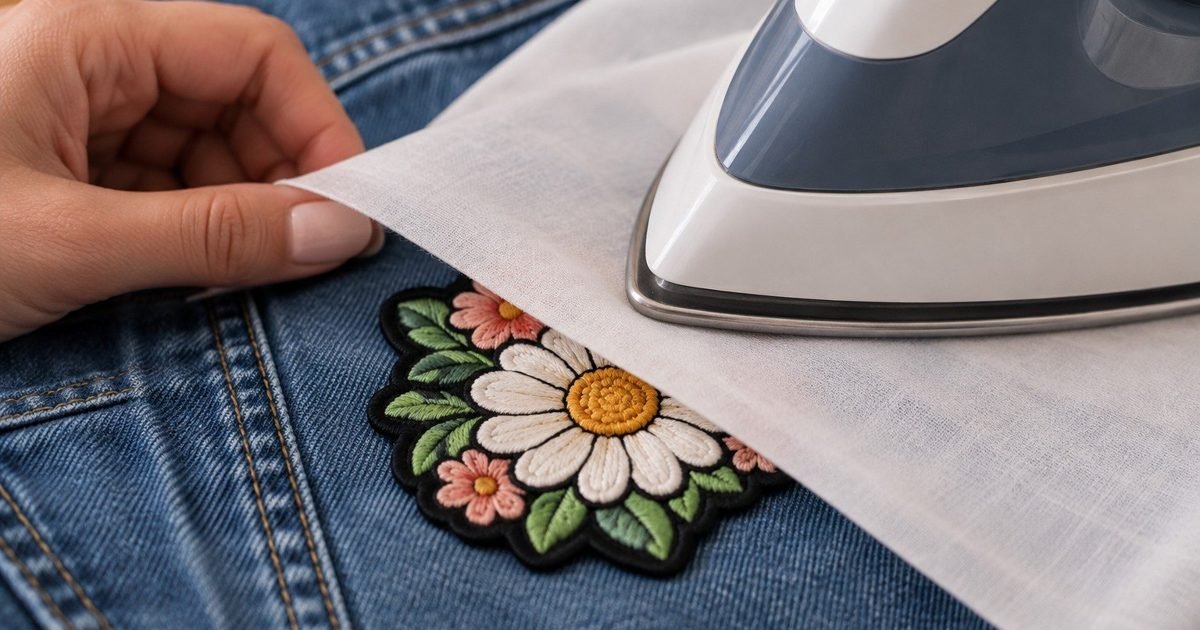
Making
Making one patch at home is straightforward and genuinely satisfying. Making forty that all look the same is a different job, and the thing that usually defeats people is not the artwork — it is the edge.
Short answer. For a one-off, back a design with fusible web and cut it out: felt or twill plus embroidery for something durable, printable transfer sheet for something photographic. Seal the edge with fray stopper or a satin stitch, or it will unravel on the first wash.
What makes a patch “iron-on”
Nothing about the face of the patch. Iron-on refers only to the backing — a thin thermoplastic film that melts under heat, flows into the weave of the garment and sets hard as it cools. Any patch can be made iron-on by fusing that film to its back, and that film is sold as fusible web or double-sided fusible interfacing in any haberdashery.
So making an iron-on patch is really two separate problems: making something worth putting on a garment, and giving it a back and an edge that survive being worn.
Method one: fusible web on embroidered felt or twill
This is the method that produces something resembling a real patch, and the one worth the effort.
- Choose the base. Wool-blend felt is forgiving and does not fray. Cotton twill is closer to a commercial patch but frays badly and needs a sealed edge.
- Stabilise it. Iron a piece of cut-away stabiliser to the back before you stitch anything, or the embroidery will pucker the base.
- Stitch the design. By machine or by hand. Keep the detail coarse — a home machine and a hand needle both struggle below about 5 mm of lettering, the same limit that applies commercially.
- Finish the outline. Run a satin stitch around the shape before cutting. This is the step that separates a patch from a scrap of decorated felt.
- Fuse the backing. Iron a sheet of double-sided fusible web to the back, paper side out, then cut the patch out through both layers just outside the satin stitch.
- Peel and apply. Remove the paper backing, position on the garment, press for 15 to 30 seconds with firm pressure and no steam.
Method two: printable transfer sheet
For photographic or full-colour artwork, an inkjet transfer sheet printed at home gets you there in twenty minutes. It is also the least durable option: the image sits on the surface rather than in the fibre, so it cracks and fades with washing in a way stitched thread does not.
Print mirrored, cut close, and be aware that the sheet carries a visible film edge around the design unless you trim tight to the artwork. If you want full-colour that lasts, this is the home version of sublimated patches — and the commercial process dyes the fibre rather than coating it, which is why it survives the wash.
The edge is the whole job
Every home-made patch that falls apart fails at the edge first. There are three honest ways to finish one, and one that does not work.
| Finish | How | Holds up? |
|---|---|---|
| Satin stitch | A dense zigzag around the outline, by machine or hand, before cutting out | Yes. This is what a commercial merrowed edge imitates |
| Fray stopper | A bead of liquid sealant along the cut edge, dried fully | On felt, adequately. On twill, temporarily |
| Pinking shears | Cut with a zigzag blade | Slows fraying on felt. Does nothing on woven cloth |
| A plain scissor cut | Cut and hope | No. It will unravel within a wash or two |
Where home-making stops making sense
One patch for a jacket: make it. A dozen for a family event: make them, and enjoy it. Beyond that the arithmetic turns quickly, and it is worth being plain about why.
Materials for a home patch — felt, stabiliser, thread, fusible web — land somewhere around a dollar or two per patch once you have bought a whole sheet of each, before any of your time. An embroidered patch made properly starts at $0.75 at volume, with a merrowed edge, a heat-seal back applied by machine and every piece identical to the last. At fifty pieces the commercial route is usually cheaper outright, and at a hundred it is not close.
The other thing volume buys is consistency. Hand-cut patches vary by a millimetre or two and hand-stitched ones vary more, which is invisible on one patch and glaring on a row of them down a team’s sleeves.
If you are prototyping before ordering
Making one by hand is an excellent way to decide the size before you commit to a run — hold it against the garment, look at it from three metres, and see whether the lettering reads. That is genuinely hard to judge from a screen, and it is the single most common thing first orders get wrong.
When you do order, size is quoted on the average of height and width, so a 3 by 5 inch patch is a 4 inch patch. See patch sizes and how quotes are measured.
Common questions
What fabric should a home-made patch be?
Wool-blend felt for ease, cotton twill for authenticity. Avoid anything stretchy as a base — it distorts under embroidery and will not sit flat on the garment afterwards.
Can I use hot glue instead of fusible web?
It will hold for a while and it will not survive a wash. Hot glue stays slightly flexible, picks up lint at the edges, and goes brittle with repeated laundering. Fusible web costs very little and behaves the way the commercial film does.
Will a home-made iron-on patch survive the washing machine?
The adhesive usually will not, on its own. Iron it on to position it, then stitch around the edge. That advice is the same for commercial patches — see how to iron on a patch for why heat-seal alone tends to lift.
Can I make a patch for a nylon jacket or a backpack?
Make the patch by all means, but do not iron it on. Nylon melts below the temperature fusible web needs. Sew it, or fit a hook-and-loop panel — see putting a patch on a backpack.
What is the minimum if I have them made instead?
Fifty pieces per design, with a free digital proof before anything runs, 10 to 12 business days as standard and 5 to 7 on a rush at no extra charge.
More in this section: how to apply a patch — every application method, compared and step by step.
Need patches made?
We make embroidered, chenille, woven, leather, PVC and sublimated patches to order, from 50 pieces, with a free digital proof before anything runs.