
Application
Heat put the patch on, and heat is how you remove an iron-on patch again. The difficulty is never the patch — it is the adhesive shadow left behind, and whether the fabric underneath will survive a second pressing.
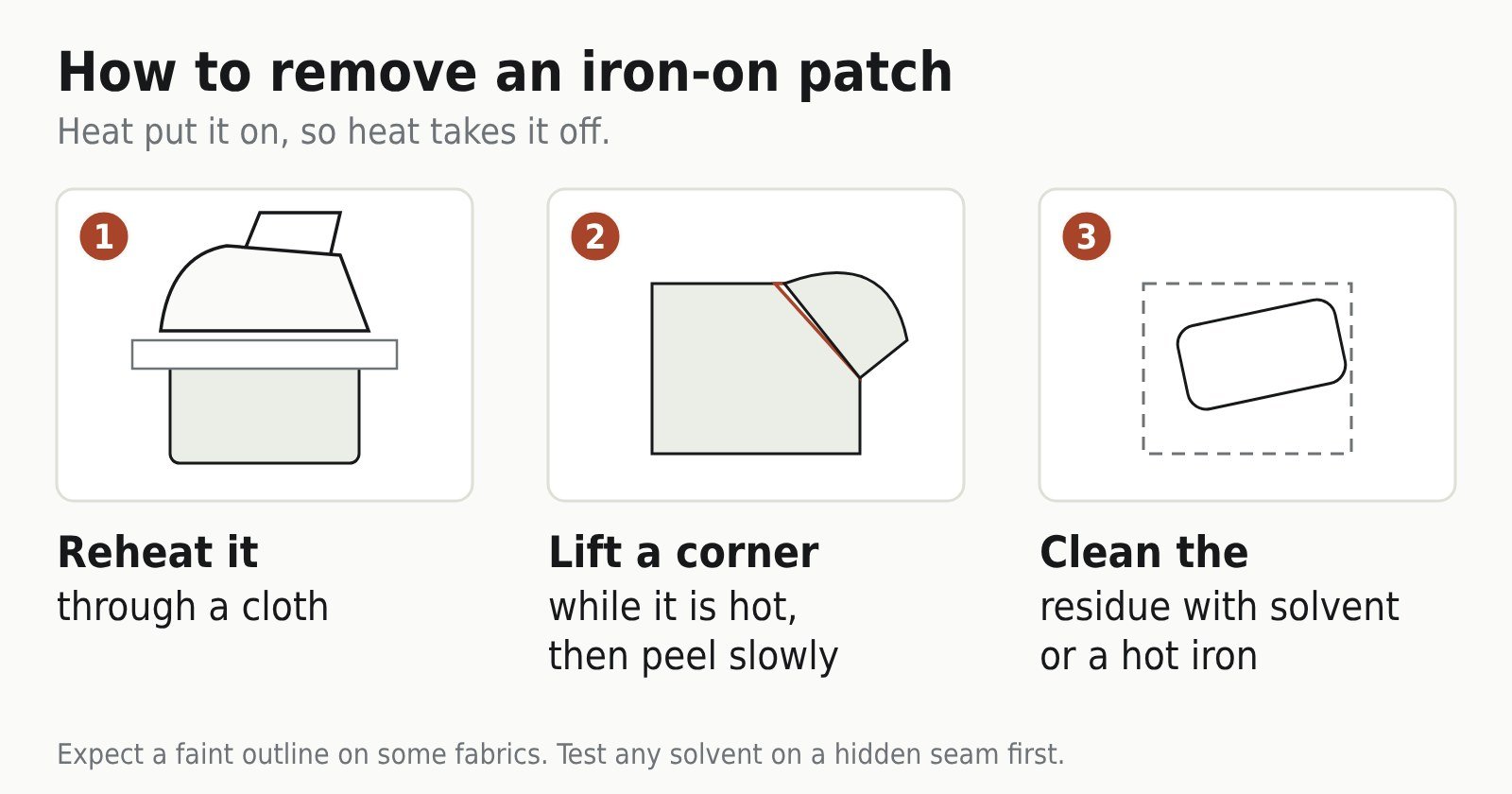
Short answer. Reheat the patch through a cloth, lift a corner while it is still hot, and peel slowly. Expect a residue outline. Solvent or a hot iron and a clean cloth will lift most of it, but the fabric may hold a faint mark for good.
What you are actually undoing
An iron-on patch is held by a thermoplastic film that was melted into the weave of the garment and allowed to set. Nothing chemical happened. The film simply flowed around the fibres and hardened there, so removal is a matter of getting it back above its softening point and pulling it out of the cloth before it cools again.
That is why removal is a heat job, not a solvent job. Solvents dissolve what is left on the surface afterwards; only heat releases the bond itself.
The method
- Check the fabric first. If the garment could not safely take an iron-on in the first place — nylon, a waterproof shell, anything with a coating — do not press it now either. Skip to the section on fabrics below.
- Work from the back where you can. Turn the garment inside out and heat the reverse of the area. The adhesive is nearer that face, and the patch itself shields the front from the iron.
- Use a pressing cloth. A cotton tea towel between iron and garment. Set the iron to the highest setting the fabric tolerates, no steam.
- Press, do not slide. Fifteen to twenty seconds, lift, check a corner with a fingernail or tweezers. Repeat rather than pressing longer.
- Peel while hot. Once a corner lifts, pull slowly and steadily at a shallow angle, keeping heat on the section still attached. If it resists, stop and reheat — forcing it takes fibres with it.
- Deal with the residue while warm. Press a clean cloth over the remaining adhesive; some of it transfers to the cloth. Move to a fresh part of the cloth each time.
The residue, and what actually shifts it
Almost every removal leaves an outline: a slightly stiff, slightly darker patch-shaped area where adhesive stayed in the weave. How much comes out depends on how long the patch was on and how hot it originally went down.
| Approach | What it is good for | Watch out for |
|---|---|---|
| Hot iron and a clean cloth | Lifting the bulk of softened adhesive | Working the cloth into the fabric and setting it further |
| Rubbing alcohol | Light residue on cotton and denim | Test on a seam allowance first; it can move dye |
| Adhesive remover (citrus or solvent) | Heavy, aged residue | Never on waterproofs, coatings or anything with a membrane |
| A stiff brush, dry | Loose crumbs after heat | Brushing hard enough to fluff the nap permanently |
Be realistic about the finish. On dark cotton that has been washed many times, the fabric under the patch is less faded than the fabric around it, so even perfect adhesive removal leaves a visible ghost. Nothing takes that out.
Fabrics where you should not try
Reheating carries the same risks as the original application, and the garment has usually had years of wear since. These are the ones to take to an alterations shop rather than an ironing board.
- Nylon and technical shells. The face melts below the temperature the adhesive needs, and a waterproof membrane behind it is destroyed silently.
- Leather, suede and waxed cotton. Heat marks hide permanently and wax migrates. Cold removal only, and slowly.
- Fleece and knitwear. The pile is already crushed under the patch; pressing again sets that for good.
- Flame-resistant and high-visibility workwear. Modifying these can void the garment’s certification. Ask the manufacturer.
- Anything vintage or collectable. If the patch itself has value, see how to identify and date an old patch before you touch it with an iron.
If the patch was sewn, not ironed
Sewn patches come off more cleanly and more slowly. Work from the back with a seam ripper, cutting one stitch every few centimetres rather than dragging along the seam, then pull the thread out from the front. The needle holes stay, but they close up considerably after a wash and a press.
If the patch is hook-and-loop, there is nothing to remove at all — that is the entire point of the construction. See what is a hook-and-loop patch.
Removing it to reuse it
A patch that comes off in one piece can usually go back on, but not with its original adhesive — the film that is left is uneven and has already been heat-cycled twice. Trim any loose film flush with scissors, then either stitch it down or apply a fresh sheet of fusible web cut to the patch shape.
If it is going somewhere it will need to come off again — a different garment each season, a rotating name or rank — back it with hook and loop instead. See Velcro patches.
Common questions
Will removing it damage the garment?
Usually not structurally, but it will almost always leave a mark. Expect a stiffened outline, a colour difference where the cloth was shielded from light and washing, and on thin fabrics a slight distortion of the weave. Plan for a visible trace rather than an invisible repair.
Can I use a hairdryer instead of an iron?
No. A hairdryer moves hot air but applies no pressure and cannot hold the adhesive above its softening point through the thickness of a patch. The same reasoning that rules it out for applying patches rules it out for removing them — see applying a patch without an iron.
Does freezing work?
It helps with some sticker adhesives, not with heat-seal film. Cold makes the film brittle rather than releasing it, so the patch may crack off while the adhesive stays exactly where it is. Heat is the only route.
What about a heat press?
If you have one, it is the better tool for exactly the reasons it is better for applying: even temperature across the whole face and real, measured pressure. Set it to the application temperature, press for ten seconds, open it and peel immediately.
The patch is glued, not ironed. Now what?
Fabric glue does not respond to heat the way heat-seal film does, and most fabric adhesives are not meant to be reversible at all. Try a citrus-based adhesive remover from the back, patiently, and accept that the residue may be permanent. It is one of the reasons we do not recommend glue for anything that matters.
More in this section: how to apply a patch — every application method, compared and step by step.
Need patches made?
We make embroidered, chenille, woven, leather, PVC and sublimated patches to order, from 50 pieces, with a free digital proof before anything runs.
Can you remove an iron-on patch?
Yes. Almost every iron-on patch can be removed, because the adhesive is a thermoplastic film that softens again when it is reheated. The patch itself usually comes off cleanly; what stays behind is a faint adhesive outline, which solvent and a second pressing through a clean cloth will reduce.
Do iron-on patches come off on their own?
They can. A patch pressed with a household iron often lifts at the edges after repeated hot washes or tumble drying, because the iron never got the adhesive fully into the weave. Washing inside out on a cool cycle and air drying keeps one on far longer, and a few stitches round the edge stops it lifting for good.
How do you take off an iron-on patch without an iron?
Use another heat source that reaches the same temperature: a hair straightener on small patches, or a heat press. A hairdryer will not do it: it cannot hold the adhesive above its softening point through the patch.