
Collecting
You cannot date a patch from a photograph, and you cannot date it from the design. What you can do is read its construction — how the edge was finished, what the base is, what is on the back — and narrow the field considerably before you ask anyone else.
Short answer. Record six things: the edge finish, the base cloth, the backing, the thread, the size, and any maker’s mark. Together they tell you roughly how a patch was made, which narrows when and where. No single feature dates anything on its own, and every one of them has been reproduced.
Read the construction, not the design
Designs are copied endlessly. A unit emblem drawn in 1943 is still being drawn today, and a reproduction can be visually perfect. Manufacturing is much harder to fake convincingly, because it means using the period’s machinery and materials rather than the period’s artwork.
So the questions worth asking are all about how the object was made. None of them is conclusive alone. Together they build a picture.
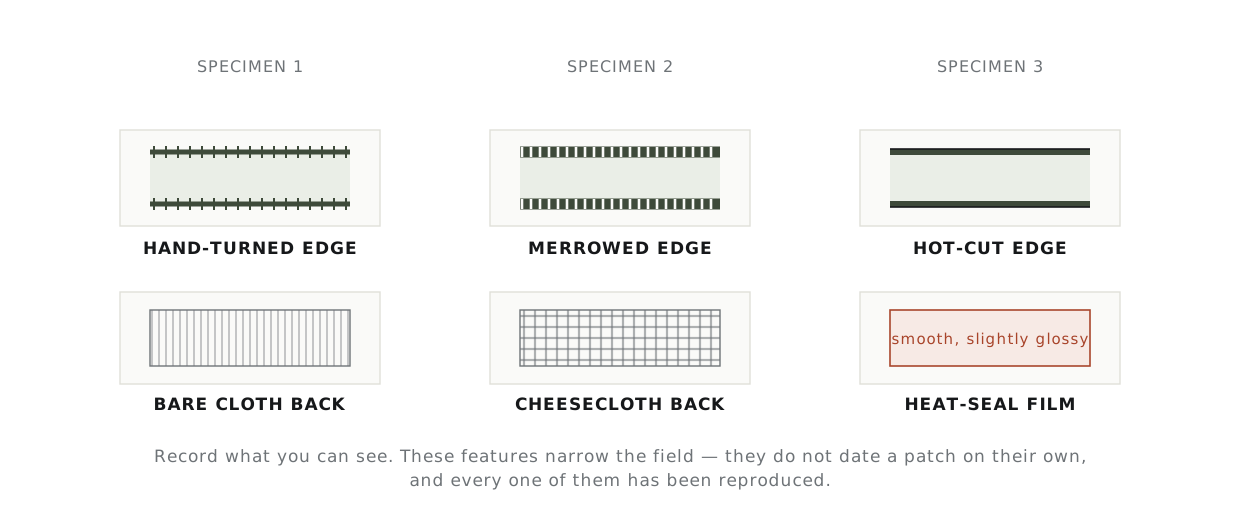
The six things to record
1. The edge
- Hand-turned or hand-embroidered edges — the cloth folded under and stitched, or the border worked by hand — indicate a patch made before or outside industrial production. Look for slight irregularity in the stitch spacing.
- A merrowed edge, the raised overlock bead, means a merrow machine, which limits the outline to shapes with no inside corners.
- A hot-cut or laser-cut edge — sealed, flat, often with a satin stitch just inside it — is a modern industrial finish and effectively rules out an early patch.
2. The base cloth
Turn a corner over and look at what the embroidery sits on. Wool felt, cotton twill and synthetic twill all feel and look different, and a synthetic base narrows the possibilities considerably. Felt with moth damage tells you something about age and something about storage.
3. The back
- Bare cloth, with the stitching visible from behind, is the simplest construction.
- Cheesecloth or gauze bonded across the back is a stabilising layer used in some periods and regions.
- A smooth, slightly glossy film is heat-seal adhesive — modern, and by itself enough to answer the question for most people.
- Hook tape is contemporary, though it is regularly added later to older patches, so it dates the modification rather than the patch.
4. The thread
Cotton and rayon threads have a different sheen from modern polyester, and they age differently — rayon in particular takes on a distinct dulling. Look at a colour in raking light rather than straight on. This one is a feel that takes handling several examples to develop, and it is worth being honest with yourself about not having it yet.
5. Size and shape
Measure it properly, in millimetres, and record the shape. Reproductions are frequently a few millimetres out from the original, because they were scanned from a photograph rather than made from a pattern. This only helps once you have a documented reference to compare against — but it is the single most useful thing to have written down when you find one.
6. Marks
Maker’s marks, contract numbers, stock numbers and printed labels on the back are the closest thing to a date stamp you will get. Photograph them before doing anything else, including cleaning.
Photograph it before you touch it
- Front and back, flat, in daylight, with a ruler or scale bar in the frame.
- A raking-light shot — light from one side at a shallow angle — which reveals stitch direction and surface damage that flat light hides.
- A close-up of one edge and of any mark.
- Note where it came from and what you were told about it. Provenance is half the value, and the story is lost the moment it is not written down.
Do not clean, trim, re-back or re-sew anything before it is identified. Every one of those reduces both the information available and, if the patch turns out to be of interest, its value. The urge to tidy an old patch is strong and should be resisted.
Where to take it next
Construction narrows the field; it will not name a unit. For that you need a documented reference, and the people who have them are generous with their time:
- Regimental, unit and service museums hold reference collections and will usually look at a clear photograph.
- Collector societies for the relevant service or period keep published reference works with documented examples.
- Veterans’ associations often know insignia that never appeared in any official publication, particularly locally made and theatre-made pieces.
- Auction archives from established militaria houses are a useful comparison set, because lots are described in detail and photographed well.
A word on reproductions
Reproduction is a legitimate and necessary part of this field. Re-enactment, film work and museum display all depend on it, and a well-made reproduction is a good object in its own right.
The norm that keeps it legitimate is simple: reproductions are described as reproductions, at every point of sale and in every collection record. A patch sold as original when the seller knows otherwise is fraud, and a patch recorded honestly loses nothing.
Related: how patches are constructed covers the manufacturing methods in detail, and displaying a patch collection covers mounting and storage that will not damage what you have identified.
Common questions
How do I tell how old a patch is?
Read the construction rather than the design. Record six things: the edge finish, the base cloth, the backing, the thread, the size, and any maker’s mark. No single feature dates a patch on its own, and every one of them has been reproduced.
Why can’t I date a patch from its design?
Designs are copied endlessly. A unit emblem drawn in 1943 is still being drawn today, and a reproduction can be visually perfect. Manufacturing is much harder to fake convincingly, because it means using the period’s machinery and materials rather than the period’s artwork.
What does the edge finish tell me?
A merrowed edge — the raised overlock bead — means a merrow machine, which limits the outline to shapes with no inside corners. A hot-cut or laser-cut edge, sealed and flat with a satin stitch just inside it, is a modern industrial finish and effectively rules out an early patch.
What should I look for on the back?
Bare cloth with the stitching visible from behind is the simplest construction. Cheesecloth or gauze bonded across the back is a stabilising layer used in some periods and regions. A smooth, slightly glossy film is heat-seal adhesive, which is modern. Hook tape is contemporary, though it is regularly added to older patches later.
Have these made
Need patches made?
We make embroidered, chenille, woven, leather and PVC patches to order — from $0.75 a patch, with a free digital proof before production and any backing you need.