
Application
There is one good substitute for an iron, one that works on small patches, and a long list of suggestions that circulate online and do not work. Knowing which is which saves a garment.
Short answer. A heat press does the job better than an iron ever will. A hair straightener works on patches up to about 2 in. A steamer, a hair dryer and a microwave do not work at all, for the same reason: heat-seal film needs dry heat, firm pressure and time held together, and those methods supply at most one of the three.
What the adhesive actually needs
The back of an iron-on patch is a thermoplastic film. It does not glue in the ordinary sense — it melts, flows into the weave of the fabric, and then sets as it cools. Getting that to happen needs three things at once, and every failed method fails because it is missing at least one.
- Heat, held at the film’s melting range for the whole patch, edges included. The exact range depends on the film, which is why the supplier’s instruction sheet beats any general figure.
- Pressure, firm and even, to push the melted film into the fabric rather than letting it sit on the surface.
- Time, because the centre of a patch reaches temperature long before its edges do.
And then a fourth thing that is not optional: cooling under pressure. The bond forms as the film sets, not while it is molten. Lifting the patch to check on it is how a good press becomes a bad one.
What works
A heat press — the real answer
A heat press applies a set temperature across a flat platen with measurable pressure for a timed interval. That is all three requirements, controlled, which is why every commercial decorator uses one and no commercial decorator uses an iron. Small clamshell presses are not expensive, and any local print shop will press a patch for a few pounds or dollars if you ask.
If you are pressing yourself: use a cover sheet, set the pressure firm rather than crushing, and press again from the inside of the garment afterwards. On a cap, use a cap press or a curved platen — a flat press bridges the crown and bonds only the middle.
A hair straightener, for small patches
A flat iron is a genuinely good substitute at small sizes. The plates are flat, they hold a set temperature, and squeezing the handle gives you real pressure — more than most people apply with a clothes iron.
- Set it to a medium heat and let it come fully up to temperature. Straighteners cycle, so give it a couple of minutes.
- Position the patch and cover it with a thin cotton cloth or a piece of baking parchment.
- Clamp the plates over one section, squeeze firmly and hold. Do not slide.
- Work across the patch in overlapping bites, doing the perimeter twice.
- Turn the garment inside out and clamp along the same path from the back.
- Let it cool completely before you move it.
The limit is plate size. Above about 2 in you are making so many overlapping presses that the first area has cooled before the last is done, and the result is a patch attached in patches.
Someone else’s press
Worth saying plainly: a local embroidery shop, print shop, sign maker or dry cleaner very often has a press and will do this while you wait. If the patch matters — a badge that took a year to earn, a jacket that cannot be replaced — this is the option to take.
What does not work
| Method | Why it is suggested | Why it fails |
|---|---|---|
| Clothes steamer | It gets hot and it is in the cupboard | No pressure, and steam is the opposite of what the film needs — water in the weave stops the adhesive flowing into it |
| Hair dryer | Hot air, aimed | Nowhere near the temperature, and no pressure at all. It will warm the patch and do nothing else |
| Oven or microwave | Even heat | No pressure, no control, and a synthetic garment in an oven is a fire risk. Never do this |
| A hot pan or a heated spoon | Improvised pressure and heat | Uncontrolled temperature and a scorch risk to both fabric and hand. A pan hot enough to melt the film will mark most fabrics before it bonds anything |
| Fabric glue instead | It avoids heat entirely | It can work, but not the general-purpose kind — it needs a flexible fabric adhesive, and it still fails at the edges under washing |
| Sitting on it / weighting it | Pressure without heat | The film does not soften. Nothing happens |
Do not improvise with an open flame, a stove, an oven or a heat gun on a garment. Synthetic fabrics ignite and melt at temperatures well within reach of those tools, and a heat gun will scorch a fabric long before the middle of a patch reaches bonding temperature.
If the patch is not sticking
Working through these in order finds the cause almost every time.
- Check the fabric. Nylon, polyester shell, waterproof, fleece, leather, waxed cotton and anything stretchy will not take a heat-seal patch. This is the answer more often than any technique problem. See the fabric list in the application guide.
- Check the patch actually has film. Hold it to the light and feel the back. A sew-on patch has bare cloth; an iron-on patch has a smooth, slightly shiny layer. Plenty of patches sold as “patches” are sew-on.
- Check for steam and moisture. Steam off, reservoir empty, and pre-press the area dry before positioning.
- Check the time. Most people press for a fraction of what is needed. Follow the supplier’s dwell time, and do not judge it by the centre.
- Check the pressure. Body weight through a straight arm, not the weight of the appliance.
- Check whether it cooled under pressure. Lifting to peek is the most common single mistake.
- Check the edges specifically. If the middle holds and the perimeter lifts, the method was fine and the coverage was not.
If the film has already been heated and cooled several times it loses adhesion permanently. At that point re-pressing will not recover it — the patch needs stitching, or a fresh heat-seal sheet cut to shape and placed behind it.
The honest recommendation
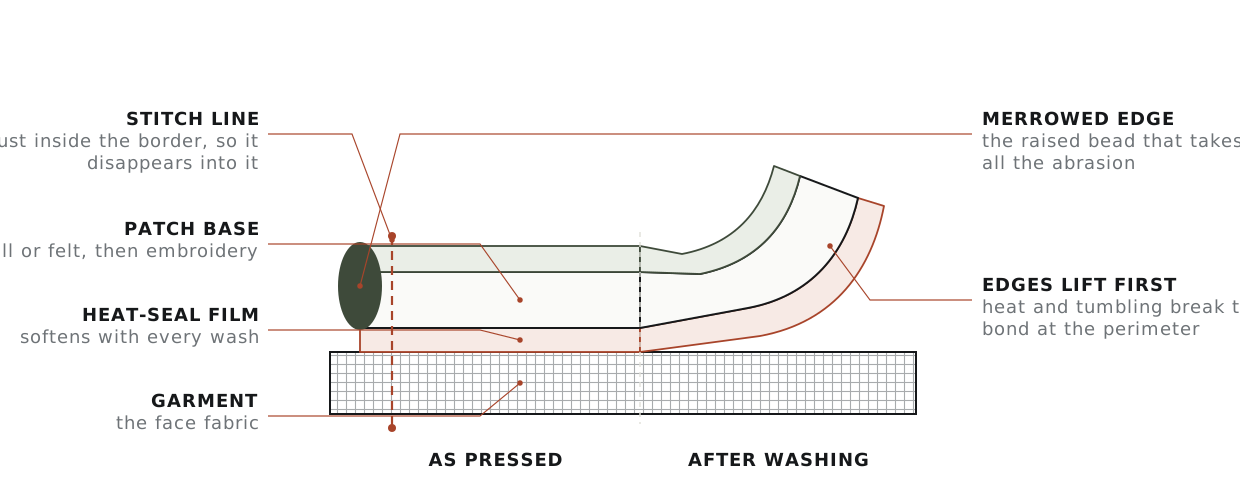
Every method above is a way of attaching something temporarily. Heat-seal film softens each time the garment is washed and the edges lift first, whatever pressed them. If you want the patch to still be there in a year, the answer is not a better press — it is a stitch line just inside the border, which takes about ten minutes by hand and removes the problem completely.
Use heat to position it. Use thread to keep it. The full method is in how to apply a patch, and why iron-on patches lift after one wash covers the mechanism in more detail.
Common questions
Can you iron on a patch with a hair straightener?
Yes, on patches up to about 2 in. The plates are flat, they hold a set temperature, and squeezing the handle gives you real pressure. Above that size it cannot cover the patch evenly.
Will a hair dryer, a steamer or a microwave attach a patch?
No. Heat-seal film needs dry heat, firm pressure and time held together, and those methods supply at most one of the three.
What is the best tool for applying a patch?
A heat press. It applies a set temperature across a flat platen with measurable pressure for a timed interval — all three requirements, controlled. Any local print shop will press a patch for a few pounds or dollars if you ask.
How do I know whether it worked?
Check the perimeter. The edges get the least heat, the least pressure and the most abrasion, so if the perimeter is not properly bonded the patch has not been attached.
How do you press a patch onto a cap?
Use a cap press or a curved platen. A flat press bridges the crown and bonds only the middle.
How do you put on a patch without an iron or any heat?
Sew it on. A running stitch or backstitch just inside the border, in thread that matches the patch edge, holds an iron-on patch permanently with no heat at all — the adhesive on the back simply goes unused. For patches you want to swap, choose a Velcro backing instead and sew the loop panel to the garment.
Have these made
Need patches made?
We make embroidered, chenille, woven, leather and PVC patches to order — from $0.75 a patch, with a free digital proof before production and any backing you need.