
Application
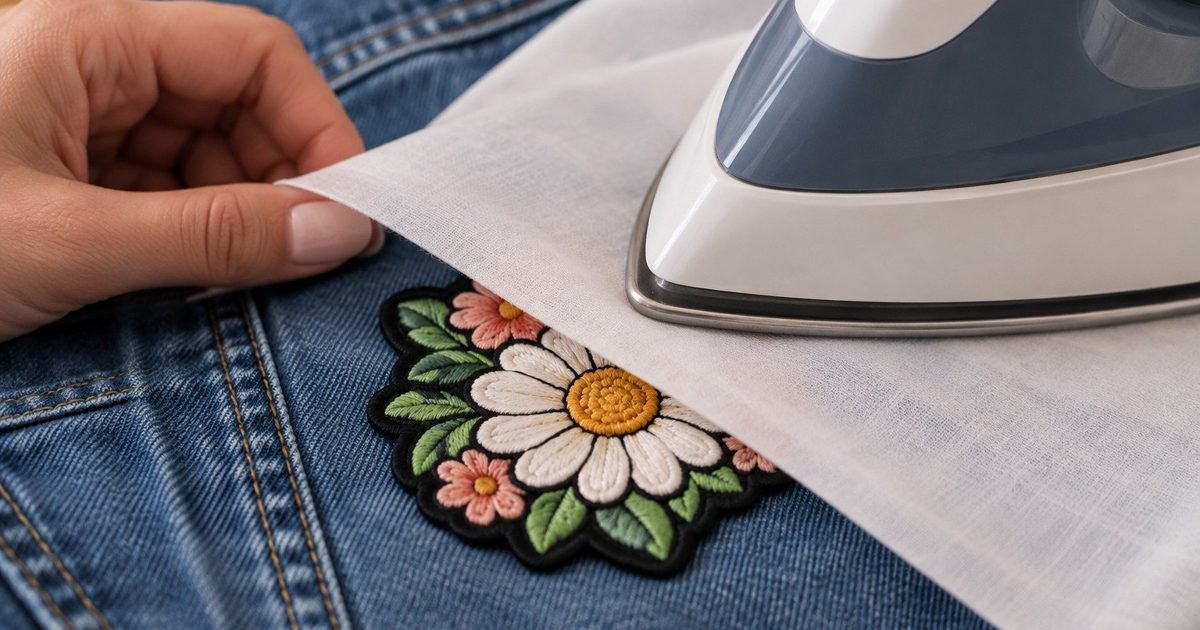
A press cloth for iron-on patches is the thin layer you put between the iron and the patch. It sounds optional, but it is what stops the patch face scorching, the thread glossing, and melted adhesive ending up on the soleplate of your iron.
Short answer. Use a thin, plain 100% cotton cloth — a pillowcase, a cotton tea towel or a handkerchief — or a Teflon sheet or baking parchment. Keep it dry: no steam, no damp cloth. Lay it over the patch and press straight down through it. Avoid anything synthetic, textured or thick.
What you can use as a press cloth
| Press cloth | Works? | Notes |
|---|---|---|
| Thin cotton (pillowcase, tea towel, handkerchief) | Yes | The classic choice. Plain weave, no print, washed so it has no finish on it |
| Teflon sheet | Yes — best | Heat-resistant, non-stick and reusable; what heat press users use |
| Baking parchment | Yes | Non-stick and cheap; use a fresh piece each time |
| Muslin or calico | Yes | Thin and cotton; fine if it is not too loose a weave |
| Thick towel | No | Absorbs heat and pressure, so the adhesive never fully melts |
| Polyester or nylon fabric | No | Can melt or glaze onto the patch |
| Wax paper | No | The wax melts onto the patch and garment |
| Damp cloth | No | Steam cools the adhesive and stops it bonding |
Why you need one
- Protects the patch face. Direct iron contact scorches thread and flattens texture, especially on embroidered and chenille patches.
- Stops shine. Polyester threads and poly-blend fabrics go glossy where an iron touches them.
- Keeps adhesive off the iron. A little adhesive always squeezes out at the edge; the cloth catches it.
- Spreads heat evenly over the steam holes in the soleplate, which otherwise leave cold spots.
How to use a press cloth on an iron-on patch
- Set the iron to cotton, steam off, and let it heat fully.
- Place the patch on the garment on a hard, flat surface.
- Lay the dry press cloth over the patch and a little beyond its edges.
- Press straight down hard for about 30 seconds without sliding the iron.
- Turn the garment inside out and press the back for about 20 seconds, with the cloth over the fabric if it is delicate.
- Let everything cool before lifting the cloth or touching the patch.
The full method, including why pressure matters more than heat, is in how to iron on a patch.
Common questions
What can I use instead of a pressing cloth?
A thin cotton pillowcase or tea towel, a Teflon sheet or baking parchment. All three work; parchment is the easiest to find in a kitchen.
Should the press cloth be damp for iron-on patches?
No. A damp cloth makes steam, and steam cools the adhesive so it does not bond. Iron-on patches need dry heat.
Can I use parchment paper for iron-on patches?
Yes. Baking parchment is heat-resistant and non-stick, so it makes a good press cloth. Do not use wax paper, which melts.
Do I need a press cloth with a heat press?
Yes — use a Teflon sheet or parchment. It protects the patch face and keeps adhesive off the platen. Settings are in heat press patches.
Have these made
More in this section: how to apply a patch — every application method, compared and step by step.
Need patches made?
We make embroidered, chenille, woven, leather and PVC patches to order — from $0.75 a patch, with a free digital proof before production and any backing you need.