
Patch types
Woven and embroidered patches look alike in a product photo and completely different in your hand. One is thin, flat and sharp; the other is thick, raised and textured. Which is better depends on one thing more than any other: how much fine detail is in your artwork.
Short answer. Choose woven if your design has small text, thin lines or fine detail — woven holds lettering down to about 2 mm and lies flat and thin. Choose embroidered if you want the classic raised, textured look and your design is bold — embroidery needs lettering of about 5 mm or more. Embroidered starts at $0.75 a patch, woven at $0.95.
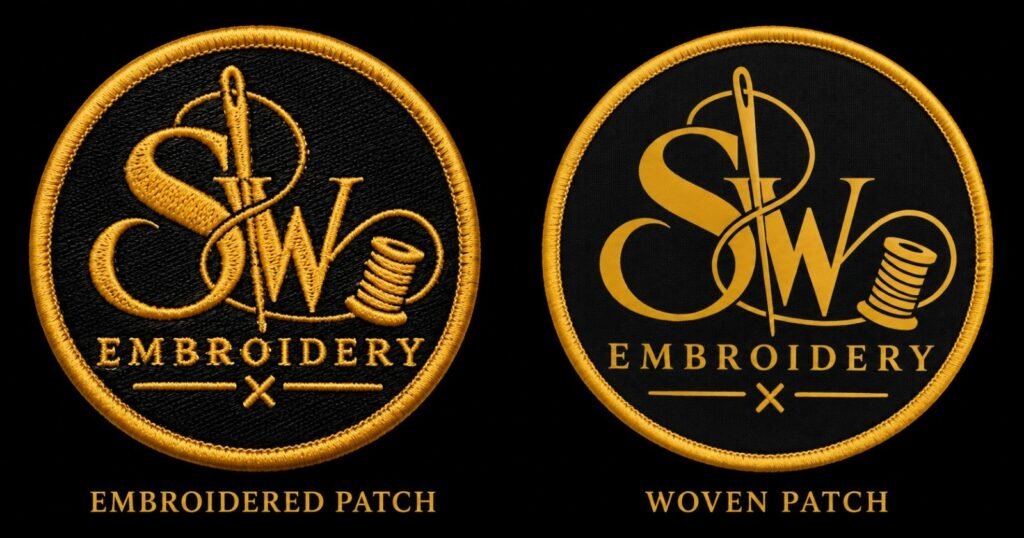
The difference in one table
| Woven patch | Embroidered patch | |
|---|---|---|
| How it is made | Threads woven together on a loom into a flat damask fabric | Thread stitched onto a twill base by an embroidery machine |
| Look and feel | Thin, flat, smooth, with a slight sheen | Raised, textured, the classic “patch” look |
| Smallest readable text | About 2 mm | About 5 mm |
| Fine lines and small logos | Excellent | Details soften and fill in |
| Thickness | Thin and flexible | Thicker and stiffer |
| Edges | Merrowed, hot cut or laser cut | Merrowed, hot cut or laser cut |
| Starting price | $0.95 | $0.75 |
When a woven patch is the better choice
- Your logo has small text — a slogan under the logo, a website address, a small date.
- The design has thin lines, outlines or fine detail that embroidery would fill in.
- The patch is small — under about 2 inches, where every millimetre of detail counts.
- You want it to sit flat and light on thin fabric, a sleeve or a hat without bulk.
- You are making labels or tags for clothing, where a thin, soft patch matters.
When an embroidered patch is the better choice
- You want the traditional raised look — club, uniform, scout, biker and workwear patches.
- The design is bold: large letters, simple shapes, strong colours.
- You want texture and depth that catches the light.
- The patch goes on heavy fabric — denim, canvas, a work jacket — where a thick patch looks right.
- You want the lowest price per patch at volume.
Price compared
Embroidered patches start at $0.75 each at volume and woven at $0.95. Embroidery is priced on how much of the patch is covered in stitches, so a fully covered embroidered patch adds 15%. Woven pricing is driven by loom set-up, so small woven patches are relatively cheap. Exact prices by size and quantity are on the price list.
Durability
Both last for years on a garment that is washed normally. Embroidered patches are thicker and shrug off rough wear; woven patches are thinner and flatter, so there is less to catch or fray. Both can take any backing — sew-on, iron-on, Velcro or peel-and-stick — and both last longest when stitched on.
Common questions
Are woven patches better than embroidered?
Not better — better at different things. Woven wins on fine detail and small text; embroidered wins on texture, the classic look and price.
Which lasts longer, woven or embroidered?
Both last for years. Embroidery is thicker and more resistant to abrasion; woven is flatter so its edges catch less. Stitching either one on matters more than which you pick.
Can a woven patch look raised?
No. Woven patches are always flat. If you want depth, choose embroidered, or PVC for a moulded 3D face.
Why is woven more expensive than embroidered?
Woven starts at $0.95 against $0.75 for embroidered, because every woven patch needs its own loom set-up. On small, detailed designs the gap is small, and woven gives a sharper result.
Do you sew the hook side or the loop side?
The loop side, onto the garment. The hook side belongs on the back of the patch, and on a made-to-order Velcro patch it is already fitted.
Can I glue or iron the loop panel on instead?
Not if the patch will be taken off and put back. Every pull puts the whole force into the panel, and adhesive gives way at a corner after a few washes. Stitch it through all four sides.
What thread is best for sewing on Velcro?
Strong polyester thread in the colour of the garment. It will not rot or shrink like cotton, and matching the garment rather than the panel hides the stitch line when no patch is fitted.
Can I sew Velcro onto a backpack or plate carrier?
Yes, and those are the places where it matters most. Use a heavy needle, go slowly through the webbing and add a second line of stitching or an X. If the bag has a lining you cannot get behind, see putting a patch on a backpack.
Is hand sewing strong enough?
Yes. A backstitch 2 mm from the edge all round is as strong as a machine line for normal use. Machine stitching is faster, not stronger.
Have these made
Need patches made?
We make embroidered, chenille, woven, leather and PVC patches to order — from $0.75 a patch, with a free digital proof before production and any backing you need.