
Display
A patch collection has two enemies and neither of them is dust. Light fades thread permanently, and adhesive of any kind destroys the thing it is holding. Everything sensible about displaying patches follows from those two facts.
Short answer. Mount patches so they can come off again — stitched to a board or a banner, pinned through a backing, or held in album pages. Keep them out of direct sun. Never glue, never tape, never trim a patch to fit a frame.
The two things that actually damage a collection
Light
Dyed thread fades, and it fades unevenly — reds and purples go first, and a patch that has hung on a sunlit wall for two summers will have a visible shadow line where the frame edge protected it. This is not reversible. If a patch matters, it does not go opposite a window, and it does not go under a spotlight.
If a display has to live in a bright room, UV-filtering glazing helps a great deal and costs a little more than ordinary glass. It slows the process rather than stopping it.
Adhesive
Glue, double-sided tape, mounting putty and self-adhesive album pages all fail the same way: the adhesive migrates into the base cloth, stains it from behind, hardens, and eventually cannot be removed without taking threads with it. Album pages sold as “magnetic” are the worst of these — they are not magnetic, they are adhesive, and they yellow.
The rule that solves it: every mounting method should be reversible in five minutes with nothing sharper than a seam ripper. If it is not, do not use it.
Four ways to display patches
1. Framed, stitched to a mount board
The best-looking option and the kindest to the patch. The patch is held with a few loops of fine thread passed through an acid-free mount board, and a spacer keeps the glazing off the surface so the thread is not crushed flat against glass.
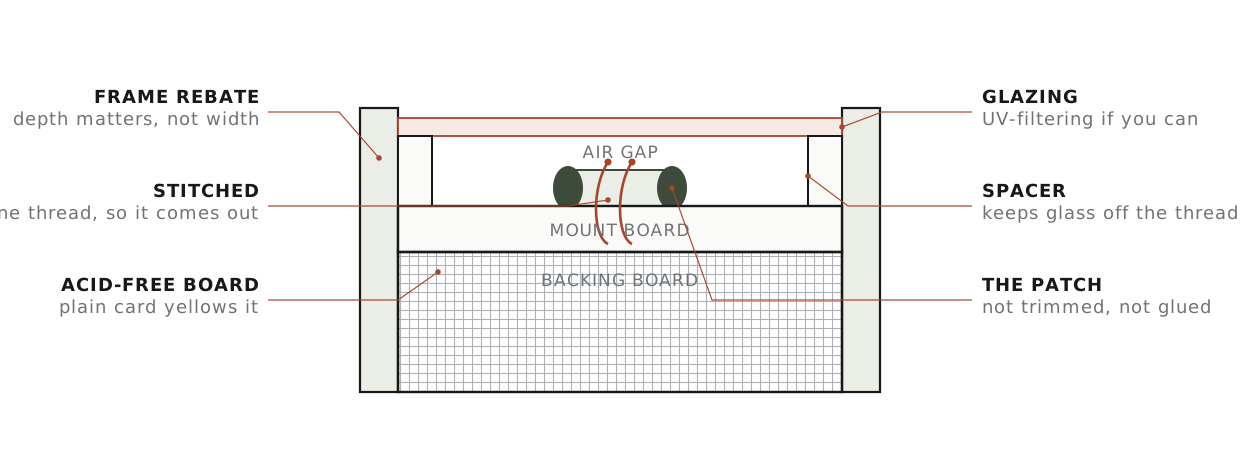
- Acid-free board, front and back. Ordinary mount card is acidic and will yellow the patch from behind within a few years, in a rectangle you can see.
- A spacer — a strip of board inside the rebate, or a deep box frame. Thread pressed against glass flattens permanently and picks up condensation.
- Fine thread, matched to the patch, in a handful of loops through the border. Not through the embroidery.
- A sealed back, taped along the frame edge, to keep dust and insects out.
2. A felt or canvas banner
The traditional Scout and club solution, and it scales better than framing. Patches are sewn to a length of felt, canvas or heavy cotton with a dowel top and bottom. It rolls for storage, it can grow, and nothing is permanent.
Choose a fabric heavy enough not to sag between patches. Lay the whole arrangement out flat and photograph it before you sew anything, because the composition is much easier to fix on the floor than on the wall.
3. Pinned to a covered board
A cork or foam board covered in fabric, with patches held by stainless steel pins through the border. Fully reversible, endlessly rearrangeable, and the cheapest of the four.
Use stainless or brass pins. Ordinary steel dressmaker’s pins rust in a few humid seasons and the rust marks are permanent.
4. Album pages
For a collection too large to display at once. Use archival polypropylene or Mylar pages — the same ones coin and stamp collectors use — and avoid PVC, which off-gasses and softens over time. Store the album flat rather than upright so the patches do not slump inside their pockets.
Arranging it
The composition is what makes a display look considered rather than accumulated. Three things do most of the work.
- Pick one alignment and hold it. Either everything is on a grid, or everything is deliberately loose. A grid with three patches slightly off it looks like a mistake; a genuinely free arrangement does not.
- Let the gaps be even, not the patches. Patches are different sizes and shapes. Equal spacing between edges reads as ordered; trying to make the patches themselves line up does not work.
- Put the largest piece off-centre. Dead centre makes everything else look like it is orbiting. A third of the way in gives the eye somewhere to start.
If the collection has a story — a sequence of ranks, a run of years, a tour — arrange it in that order and the display explains itself without a caption.
Cleaning, carefully
Most patches need nothing more than a soft brush. If one genuinely needs cleaning, test on the back first, work with the smallest amount of moisture that does anything, and never soak a patch with a felt base or a paper-stiffened back.
Anything with real historical or personal value — a decoration, an issued badge, something inherited — is worth asking a textile conservator about before you clean or mount it. Most museums will answer a short question by email, and it costs nothing to ask.
Storage for what is not on the wall
- Flat, not folded. A fold line in a stiff patch becomes a crack.
- Acid-free tissue between layers, not cling film or a plastic bag.
- Somewhere with a stable temperature. Lofts and garages swing too far and condense.
- Away from the wardrobe. Moths eat wool felt bases, and plenty of older patches have one.
Related: what your patches are made of decides how delicate they are, and how to identify and date an old patch covers the construction features worth recording before anything goes behind glass.
Common questions
What is the best way to display a patch collection?
Framed and stitched to an acid-free mount board, with a spacer keeping the glazing off the surface. A few loops of fine thread hold the patch, and the spacer stops the thread being crushed flat against the glass.
Can I glue patches into a display?
No. Adhesive of any kind destroys the thing it is holding. Every mounting method should be reversible in five minutes with nothing sharper than a seam ripper — if it is not, do not use it.
Are “magnetic” album pages safe?
No. They are not magnetic, they are adhesive, and they yellow.
Does sunlight really damage patches?
Yes, permanently and unevenly. Reds and purples go first, and a patch that has hung on a sunlit wall for two summers will have a visible shadow line where the frame edge protected it. This is not reversible.
Does the mount board matter?
Ordinary mount card is acidic and will yellow the patch from behind within a few years, in a rectangle you can see. Use acid-free board front and back.
Have these made
Need patches made?
We make embroidered, chenille, woven, leather and PVC patches to order — from $0.75 a patch, with a free digital proof before production and any backing you need.