
Insignia
A cut, the patched motorcycle vest a club member wears, is a document. Read in the right order it tells you what kind of club the wearer belongs to, where that club sits, and what the wearer’s role in it is. Read wrongly — which is what most of the internet does — it tells you a great deal of folklore.
Short answer. The three patches on the back are the colours: club name on top, the club’s own mark in the middle, territory on the bottom. They belong to the club, not the member. Almost every “secret meaning” you will read about a number or a small patch is claimed rather than documented, and this page says which is which.
The cut and the colours
The sleeveless jacket is a cut. The patches on its back are the colours. That word does most of the work in this subject, because colours are not decoration and they are not the wearer’s property. As one reference puts it, “the club patches always remain the property of the club itself, not the members, and only members are allowed to wear the club’s patches.”
The same source notes what follows from that: “a member must closely guard their colours, for allowing one’s colours to fall into the hands of an outsider is an act of disgrace and may result in loss of membership.” That is the single most important thing to understand before reading anything else on this page.
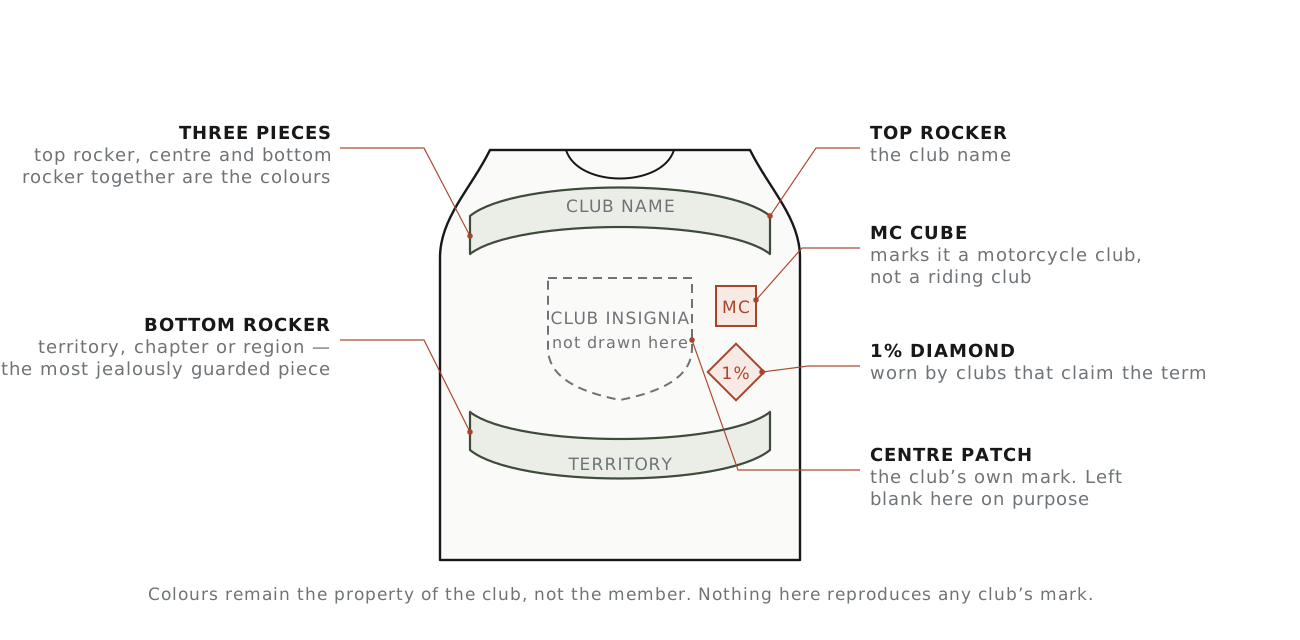
One piece, two pieces, three pieces
The number of pieces is the first thing to read, and it is a genuine convention rather than folklore. The usual description is “a one-piece patch for nonconformist social clubs, a two-piece patch for clubs paying dues, a three-piece patch for outlaw clubs.”
| Configuration | What it usually indicates |
|---|---|
| One piece | A social or riding club. Often a single round or shield-shaped patch with everything on it |
| Two pieces | A club with dues and structure, but not claiming outlaw status |
| Three pieces | Top rocker, centre and bottom rocker. The format used by outlaw clubs, and the one an outsider should never assemble |
The bottom rocker is the piece that carries the most weight, because it usually names a territory. A club claiming a region on its bottom rocker is making a statement to every other club, and that is why an outsider wearing one is not read as a fashion choice.
The MC cube
The small square reading MC sits beside the colours and marks the wearer as belonging to a motorcycle club in the formal sense, as opposed to a riding club (RC), a motorcycle association, or one of the many social groups that ride together without the structure.
The distinction matters more than it looks. RC and social groups generally have open membership and no territory. An MC in this sense is a chartered organisation with a hierarchy, a probationary process, and rules about who may wear what. Wearing the cube without the club is claiming membership of something.
The 1% diamond, and where the story came from
Some clubs wear a small diamond reading 1%. The standard explanation, repeated on nearly every page that discusses it, is that after the Hollister rally of 1947 the American Motorcyclist Association said that 99 per cent of motorcyclists were law-abiding and one per cent were not, and that certain clubs adopted the label in defiance.
That story is not documented. The AMA says it has no record of ever releasing such a statement, and its own public information director has described the attribution as apocryphal. The quotation is usually dated to 1960, thirteen years after the rally it is supposed to respond to. What is well documented is the rally itself, and that the famous Life photograph of a drunk man on a bike surrounded by bottles was, according to an eyewitness, staged by the photographer.
None of that makes the patch meaningless. Clubs that wear the diamond are claiming the term deliberately, and it is read exactly as intended. It just means the origin story is a story — and a page that tells it as settled history is telling you something about its own sourcing.
The numbers
This is where the folklore is thickest. The honest position on almost every numeric patch is that several meanings circulate, they contradict each other, and no motorcycle organisation, court record or reference work establishes any of them.
13
Claimed meanings include the thirteenth letter of the alphabet standing for motorcycle, or for marijuana, or for methamphetamine; a signal of support for cannabis legalisation; simple membership of the wider riding community; and a deliberate embrace of an unlucky number. Even mainstream coverage that lists these concludes that the patch “doesn’t have a single, universal definition” and that its meaning “shifts depending on the motorcycle club, region, and even the individual rider.”
That is the correct answer. Anyone telling you it definitely means one specific thing is guessing with confidence.
13½
The widely repeated reading is twelve jurors, one judge and a half chance. It is memorable, it is plausible, and it has no traceable origin. Treat it as a saying rather than a fact.
Named patches with lurid explanations
A number of small patches associated with particular clubs have explanations attached to them that involve violence — the “Filthy Few” patch is the most frequently discussed. The claimed meanings are repeated constantly and have never been confirmed by the clubs concerned, and they have been disputed in court reporting. This site is not going to assert them. If you are researching this seriously, published journalism and court records are the sources; a patch supplier’s blog is not.
The rest of the cut
- Position patches — President, Vice President, Secretary, Treasurer, Sergeant at Arms, Road Captain. These are offices, and they are worn by whoever currently holds them.
- Support patches are worn by people connected to a club without being full members. They carry the club’s colours in some form and are issued, not bought.
- Memorial patches for members who have died. Often dated, often the most personal thing on the cut.
- Rally and event patches, which mean exactly what they say and are the one category anyone can wear.
- Front patches vary enormously. There is no universal convention: some clubs specify the front precisely and others leave it to the member.
Why the meanings are so unreliable
Three reasons, and they compound. Clubs do not publish their internal conventions, so there is nothing authoritative to check against. Meanings genuinely do vary between clubs and regions, so two contradictory answers can both be locally true. And the commercial pages that dominate this subject have an incentive to sound certain, because certainty sells patches.
If you want to know what a specific patch means on a specific cut, the only reliable method is to ask its wearer, politely, and accept that the answer may be that it is not your business.
On reproduction. Club insignia is protected. The Hells Angels alone hold federal trademarks dating to the 1970s and have brought infringement actions against Marvel, Disney, Alexander McQueen and Saks, Toys “R” Us and Redbubble, among others. Their counsel has described the strategy as educating the public that the marks “are well guarded, not generic and must not be infringed.” Writing about insignia is lawful. Making it is a different matter entirely, and this site does not do it.
Related: which patches to avoid if you are not in a club is the practical companion to this page, building a patch jacket covers the composition side, and patch types compared covers how these are actually made.
Common questions
What is a cut?
The sleeveless jacket itself. The patches on its back are the colours.
What are the three patches on the back?
Club name on top, the club’s own mark in the middle, territory on the bottom. Together they are the colours.
Who owns a club’s colours?
The club, not the member. Only members are allowed to wear them.
Are the “secret meanings” of numbers and small patches real?
Almost every one you will read about is claimed rather than documented. This page sets out which conventions are recorded and which are folklore.
Have these made
More in this section: insignia and what it means — the rest of the insignia guides.
Need patches made?
We make embroidered, chenille, woven, leather and PVC patches to order — from $0.75 a patch, with a free digital proof before production and any backing you need.