
Placement · U.S. Air Force
Air Force placement is the one that can be checked properly. The instruction is published openly, it carries a date, and it is specific enough to quote — so this page quotes it.
Sources and date. Checked on 5 September 2026 against DAFI 36-2903, Dress and Personal Appearance, dated 29 February 2024 with corrective actions applied 13 March 2024, and the guidance memorandum DAFGM 2026-02 dated 19 February 2026. Guidance memoranda change the instruction without reissuing it — always check whether a newer one exists.
The OCP coat
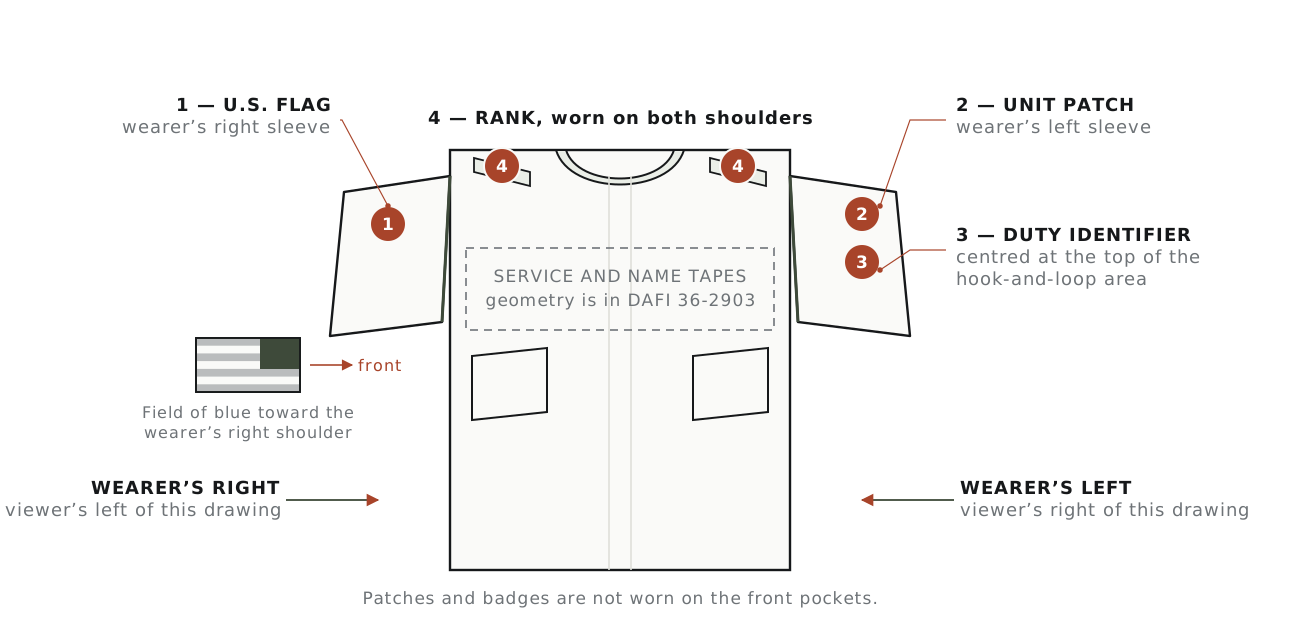
| Position | Where | What the instruction says |
|---|---|---|
| U.S. flag | Wearer’s right sleeve | “The U.S. flag will be worn with the field of blue towards the wearer’s right shoulder” |
| Unit or organisational patch | Wearer’s left sleeve | Worn on the left sleeve, above the duty identifier |
| Duty identifier patch | Wearer’s left sleeve | “centered at the top of the Velcro® area”, and it may not exceed the size of the U.S. tactical flag patch — “3-1/4″ W x 1-13/16″H” |
| Rank insignia | Both shoulders | Worn on both shoulders of the OCP coat, subdued |
| Service tape and name tape | Chest | Placement geometry is set out in the instruction’s figures and is not reproduced here |
| Front pockets | — | “Patches or badges will not be affixed to the front pockets” |
Duty identifiers
The duty identifier is the short patch some career fields wear on the left sleeve. The instruction describes it as a “spice brown subdued cloth patch centered at the top of the Velcro® area”, worn by certain Air Force Specialty Codes while performing their duties. Table 5.1 of the instruction lists the authorised identifiers and qualification tabs for the left sleeve.
- A maximum of five letters.
- Standard spice brown subdued colour scheme.
- No larger than the tactical flag patch: 3¼ in wide by 1-13/16 in tall.
- Patches with black borders distinguish first responders and career fields that need to be identified quickly.
One exception that trips people up. The instruction states that “the ‘FIRE’ duty identifier (with black border) will only be worn on the two-piece flight duty uniform” and that wear of that identifier on the OCP uniform is not authorised. This restriction is specific to the FIRE identifier — other authorised duty identifiers are still worn on OCP.
Why the flag faces the way it does
The reversed-field flag confuses people who assume it is a mistake or a special version. It is neither. The convention treats the wearer as a flagpole moving forward: the canton — the field of blue — leads, and the stripes stream behind. On the wearer’s right sleeve that puts the blue toward the front of the body, which from the outside looks like a mirror image of the flag on a wall.
This is why a flag patch bought without checking can end up facing the wrong way. The two versions are made and sold separately, and they are not interchangeable.
What this page does not cover
- Service dress and mess dress. Different uniforms, different rules, different chapters.
- The two-piece flight duty uniform, which has its own placement and its own exceptions — the FIRE identifier above is one of them.
- Space Force. Guardians follow SPFI 36-2903, a separate instruction with its own guidance memoranda.
- Entitlement. Which patches, tabs and badges you may wear is the substance of the instruction and is not something a placement drawing answers.
- Chest tape geometry. It is in the instruction’s figures, which are the part of a PDF that does not survive being summarised.
How to check it yourself
- Go to Air Force e-Publishing and pull the current DAFI 36-2903. Check the date on the cover.
- Check for a more recent guidance memorandum. These are issued between editions and they change the instruction while it stands.
- Read Table 5.1 for duty identifiers and qualification tabs, and the OCP figures for tape and badge geometry.
- Ask your unit. Major command supplements exist and they bind you on top of the instruction.
This page is a reference written by a patch site. It is not a Department of the Air Force publication and it is not endorsed by them; where it differs from the current instruction, the instruction is right. Service marks and unit emblems belong to their organisations, and nothing here is permission to reproduce or wear them.
Related: Army OCP patch placement, Scouts BSA uniform patch placement, and how placement is measured.
Have these made
Need patches made?
We make embroidered, chenille, woven, leather and PVC patches to order — from $0.75 a patch, with a free digital proof before production and any backing you need.