There is no single official rule for where patches go on a letterman jacket — every school and club has its own traditions. But the same layout turns up again and again, and following it keeps a jacket looking balanced as it fills up over four years.
Short answer. The varsity letter goes on the left chest, over the heart. The right chest takes your name or a mascot. Sleeves carry the graduation year and activity or sport emblems, and the back carries the school name or mascot. Check your school’s own rules first; many have a set layout.
The common letterman jacket layout
Position
What usually goes there
Typical size
Left chest
The varsity letter (the school initial), with sport pins or bars attached to it
5–6 in tall
Right chest
Your name (embroidered script or a name patch) or the school mascot
3–4 in
Left sleeve
Graduation year, or activity emblems
3–4 in numbers
Right sleeve
Sport, band, academic and achievement emblems, stacked downward from the shoulder
3–5 in each
Back
School name arched across the shoulders, mascot below
8–12 in
Lower front
Extra awards, captain patches or state and championship emblems
2–4 in
Left and right are as worn, not as you look at the jacket.
Rules of thumb as the jacket fills up
Start at the top. Put the first sleeve emblem just below the shoulder seam and add each new one underneath.
Keep a column. Line sleeve emblems up down the centre of the sleeve rather than scattering them.
Mind the leather. Letterman sleeves are often leather, and every stitch hole in leather is permanent — plan the layout before sewing anything.
Leave space for later years. Most students add patches over three or four years; do not fill the front in year one.
Pins go on the letter. Sport and achievement pins are traditionally pinned onto the chenille letter, not the jacket.
Attaching the patches
Chenille letters and emblems are heavy, so they are sewn on rather than ironed. Wool does not hold heat-seal adhesive well, and heat can mark leather sleeves. Stitch just inside the chain-stitch outline with thread matching the felt edge. The full method is in how to sew on a patch.
Common questions
Which side does the letter go on a letterman jacket?
The left chest, over the heart, as worn. It is the most consistent convention of all.
Where do you put the graduation year on a letterman jacket?
On a sleeve, usually near the top. Some schools use the left sleeve and some the right; if your school has a standard layout, follow it.
Where do sports patches go?
On the sleeves, stacked from the shoulder down, or as pins on the letter itself.
Can I iron patches onto a letterman jacket?
It is not recommended. Wool bodies do not hold iron-on adhesive well under heavy chenille, and leather sleeves can scorch. Sew them.
We make embroidered, chenille, woven, leather and PVC patches to order — from $0.75 a patch, with a free digital proof before production and any backing you need.
Air Force placement is the one that can be checked properly. The instruction is published openly, it carries a date, and it is specific enough to quote — so this page quotes it.
Sources and date. Checked on 5 September 2026 against DAFI 36-2903, Dress and Personal Appearance, dated 29 February 2024 with corrective actions applied 13 March 2024, and the guidance memorandum DAFGM 2026-02 dated 19 February 2026. Guidance memoranda change the instruction without reissuing it — always check whether a newer one exists.
The OCP coat
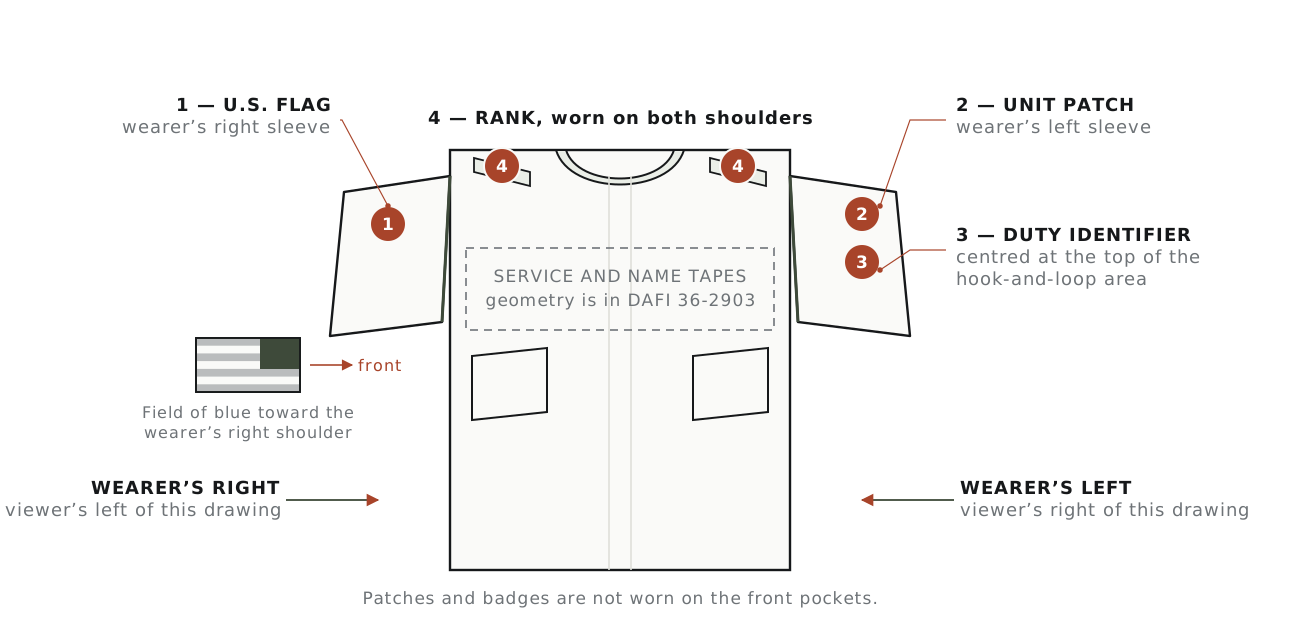
Air Force OCP coat. The flag detail is the part most often got wrong: the field of blue faces forward, so the flag reads as advancing rather than retreating.
Position
Where
What the instruction says
U.S. flag
Wearer’s right sleeve
“The U.S. flag will be worn with the field of blue towards the wearer’s right shoulder”
Unit or organisational patch
Wearer’s left sleeve
Worn on the left sleeve, above the duty identifier
Duty identifier patch
Wearer’s left sleeve
“centered at the top of the Velcro® area”, and it may not exceed the size of the U.S. tactical flag patch — “3-1/4″ W x 1-13/16″H”
Rank insignia
Both shoulders
Worn on both shoulders of the OCP coat, subdued
Service tape and name tape
Chest
Placement geometry is set out in the instruction’s figures and is not reproduced here
Front pockets
—
“Patches or badges will not be affixed to the front pockets”
Duty identifiers
The duty identifier is the short patch some career fields wear on the left sleeve. The instruction describes it as a “spice brown subdued cloth patch centered at the top of the Velcro® area”, worn by certain Air Force Specialty Codes while performing their duties. Table 5.1 of the instruction lists the authorised identifiers and qualification tabs for the left sleeve.
A maximum of five letters.
Standard spice brown subdued colour scheme.
No larger than the tactical flag patch: 3¼ in wide by 1-13/16 in tall.
Patches with black borders distinguish first responders and career fields that need to be identified quickly.
One exception that trips people up. The instruction states that “the ‘FIRE’ duty identifier (with black border) will only be worn on the two-piece flight duty uniform” and that wear of that identifier on the OCP uniform is not authorised. This restriction is specific to the FIRE identifier — other authorised duty identifiers are still worn on OCP.
Why the flag faces the way it does
The reversed-field flag confuses people who assume it is a mistake or a special version. It is neither. The convention treats the wearer as a flagpole moving forward: the canton — the field of blue — leads, and the stripes stream behind. On the wearer’s right sleeve that puts the blue toward the front of the body, which from the outside looks like a mirror image of the flag on a wall.
This is why a flag patch bought without checking can end up facing the wrong way. The two versions are made and sold separately, and they are not interchangeable.
What this page does not cover
Service dress and mess dress. Different uniforms, different rules, different chapters.
The two-piece flight duty uniform, which has its own placement and its own exceptions — the FIRE identifier above is one of them.
Space Force. Guardians follow SPFI 36-2903, a separate instruction with its own guidance memoranda.
Entitlement. Which patches, tabs and badges you may wear is the substance of the instruction and is not something a placement drawing answers.
Chest tape geometry. It is in the instruction’s figures, which are the part of a PDF that does not survive being summarised.
Check for a more recent guidance memorandum. These are issued between editions and they change the instruction while it stands.
Read Table 5.1 for duty identifiers and qualification tabs, and the OCP figures for tape and badge geometry.
Ask your unit. Major command supplements exist and they bind you on top of the instruction.
This page is a reference written by a patch site. It is not a Department of the Air Force publication and it is not endorsed by them; where it differs from the current instruction, the instruction is right. Service marks and unit emblems belong to their organisations, and nothing here is permission to reproduce or wear them.
We make embroidered, chenille, woven, leather and PVC patches to order — from $0.75 a patch, with a free digital proof before production and any backing you need.
Army patch placement on the OCP uniform: which sleeve carries what on the coat, and where to get the measurements. This page is deliberately short on numbers, and the reason is worth reading before you go looking for them elsewhere.
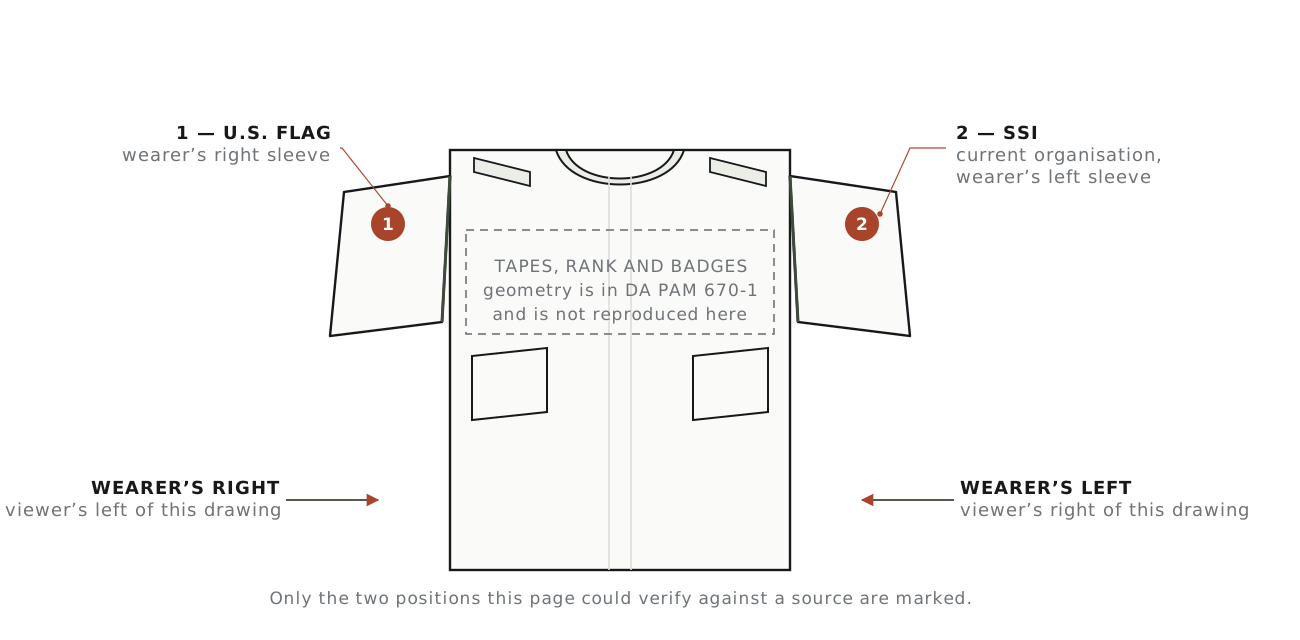
Short answer. The U.S. flag goes on the wearer’s right sleeve. The shoulder sleeve insignia for your current organisation goes on the wearer’s left. Everything else — the tapes, rank, badges, and every measurement — is set out in DA PAM 670-1, and this page does not reproduce it.
Why this page has no measurement table
Army placement is governed by two documents. AR 670-1 is the regulation; it sets policy and then explicitly hands off the detail. Its own summary of changes records that it “deletes all procedural guidance regarding uniforms, insignia, and other uniform accessories,” pointing to the pamphlet instead. DA PAM 670-1 is where the placement paragraphs and the figures actually live.
Both are published by the Army Publishing Directorate. When this page was written, that site could not be read automatically, and the copies circulating on other hosts carried four different dates — 2014, 2015, 2017 and a January 2021 edition. A measurement lifted from a superseded edition looks exactly like a current one, and there is no way to tell them apart on a patch supplier’s blog.
So this page publishes the two sleeve facts that three independent sources agreed on, and stops. If you want the tape geometry, the rank position or any figure in inches, get the current DA PAM 670-1 from the Army Publishing Directorate and read chapter 21. That is not a cop-out; it is the only version of this answer that is safe to act on.
The two sleeves
The two positions this page can stand behind. The chest area is left blank on purpose — the geometry is in the pamphlet and this drawing is not a substitute for it.
This answers the question most people are actually asking. What side does the U.S. Army patch go on? Your unit patch — the shoulder sleeve insignia for your current organisation — goes on your left arm. The flag goes on your right. If you are looking at a photograph rather than wearing the coat, both appear on the opposite side of the picture from the side they are worn on.
What the sleeves carry, and what is not confirmed here
Item
Sleeve
Confirmed here?
U.S. flag embroidered insignia
Wearer’s right
Yes — stated in DA PAM 670-1 and consistent across sources
SSI, current organisation
Wearer’s left
Yes — stated in DA PAM 670-1, and confirmed again by Army reporting in 2025
SSI-FWTS (the combat patch)
Wearer’s right, centred between the bottom of the flag and the bottom of the pocket
Not confirmed here. The sides and geometry are in the pamphlet
Grade insignia
Centre chest
Not confirmed here. Check the pamphlet
Every row marked “not confirmed” has a confident-looking answer on a dozen commercial sites. Some of those answers are probably right. None of them tells you which edition it came from, which is the only thing that would let you check.
Army combat patch placement
The combat patch is the shoulder sleeve insignia of a unit you served with during a qualifying operation in hostile conditions. Current Army guidance calls it SSI-MOHC (military operations in hostile conditions); many soldiers and older guidance still call it SSI-FWTS, former wartime service.
Sleeve: the right sleeve — the same side as the U.S. flag.
Position on the OCP coat: centred horizontally and vertically in the space between the bottom of the flag insignia and the bottom of the sleeve pocket.
Attachment: on the hook-and-loop pad. The pamphlet states it is not sewn on the combat uniform.
More than one earned: you wear one, and you choose which.
Source: DA PAM 670-1, paragraph 21-18, as reproduced by AR670.com. We could not check the Army’s own copy directly, so confirm against the current pamphlet or with your unit before a formal inspection.
One change worth knowing about
In February 2025 the Secretary of the Army issued HQDA Execute Order 123-25, directing uniformed soldiers supporting garrison operations to wear the shoulder sleeve insignia of their installation senior commander’s unit, rather than the patch they had been wearing. That changes which patch is worn, not where it goes — the SSI is still on the upper left arm.
It is a useful illustration of why dates matter on a page like this. A guide written in 2024 would have been silently wrong for a large number of soldiers within a year, and would have looked no different.
How to get the answer you can act on
Go to the Army Publishing Directorate and download the current DA PAM 670-1. Check the date on the cover before you read anything.
Read the placement paragraphs for the item you care about, not a summary of them. The figures carry the measurements.
If you are in a unit, ask your first-line supervisor or your unit’s command team. Local guidance exists on top of the pamphlet and it is binding on you.
Do not take a measurement from a patch supplier, including this site. Suppliers make the patch; they do not set where it goes.
This page is a reference written by a patch site. It is not a Department of Defense publication, it is not endorsed by the U.S. Army, and where it differs from the current DA PAM 670-1, the pamphlet is right. Unit insignia and service marks belong to their organisations; nothing here is permission to reproduce or wear them.
We make embroidered, chenille, woven, leather and PVC patches to order — from $0.75 a patch, with a free digital proof before production and any backing you need.
Boy Scout patch placement: where each badge sits on the Scouts BSA field uniform shirt, taken from the two publications that govern it rather than from another website. Every position below is quoted, and the date it was checked is on the page.
Sources and date. Checked on 5 September 2026 against the Guide to Awards and Insignia (publication No. 33066, July 2024 revision) and the Field Uniform Checklist, Scouts BSA (publication No. 510-784, June 2024). Where those two use different wording for the same position, both are given below. Check the publication before you sew. These documents are revised, and this page is a reading of them, not a substitute for them.
A note on the names
The organisation is now Scouting America. The name changed from Boy Scouts of America on 8 February 2025, announced the previous May. The programme names did not change: it is still Cub Scouting, Scouts BSA, Venturing, Sea Scouts and Exploring.
For uniforms this matters very little. New shirts carry “Scouting America” lettering over the right pocket; everything else is the same, existing uniforms stay valid, and no insignia moved. If you are searching for “Boy Scout patch placement”, this is the page you want — the positions are unchanged.
The positions
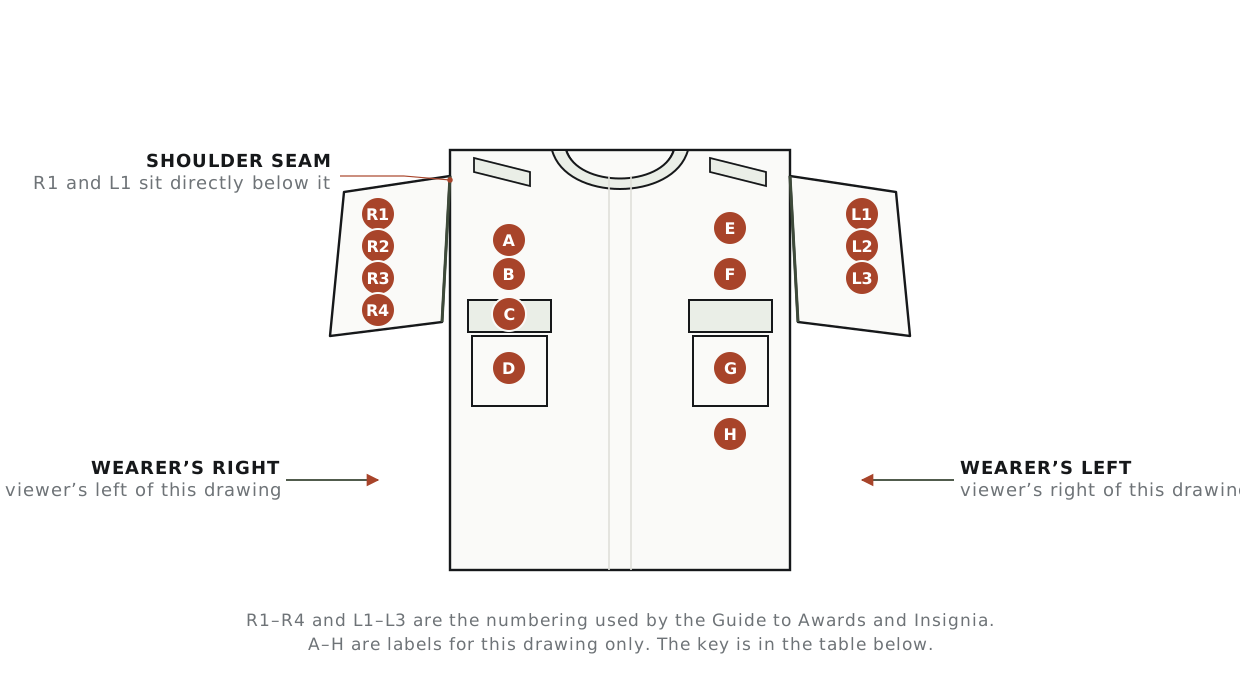
Scouts BSA field uniform shirt, front. R1–R4 and L1–L3 are the numbering the Guide itself uses. A–H are labels for this drawing only, keyed in the tables below.
Left means the wearer’s left throughout. On the drawing above, the wearer’s left sleeve is on the right-hand side. This is the single most common source of error in patch placement, and it is why the drawing says so on its face.
Sleeves
Both sleeves are numbered from the shoulder seam downwards. Position 1 sits directly below the seam on each side.
Mark
Item
What the source says
R1
U.S. flag emblem
“right sleeve, position 1, just below shoulder seam” (33066). The checklist gives it as “U.S. flag emblem centered directly below shoulder seam”
R2
Patrol emblem
Right sleeve, below the flag. See the note on numbering below
R3
Journey to Excellence award
Right sleeve, position 3. The adult leader checklist places this one “4 inches below the shoulder seam”
R4
Merit badges
“right sleeve (long-sleeve shirt only), position 4, limited to six” (33066)
L1
Council shoulder emblem
“left sleeve, position 1, just below shoulder seam” (33066)
L2
Unit numeral
“left sleeve, position 2, touching council shoulder emblem if veteran unit bar is not worn” (33066). The checklist: emblem, numeral and veteran bar “are worn as shown snug up and touching each other”
L3
Badge of office
“left sleeve, position 3” (33066). The adult leader checklist gives the same position as “centered and touching the unit numeral, or centered 4 inches below the shoulder seam”
Where the sources I could read did not agree. The Guide numbers the patrol emblem’s position on the right sleeve, but the text I was able to read did not state the number unambiguously, and one reading put both the patrol emblem and the Journey to Excellence award at position 3. They cannot both be right. The numbering implies the patrol emblem is position 2, directly below the flag, with position 3 being the four-inch mark used on both sleeves — but that is an inference, not a citation. Confirm this one against the Guide. I would rather tell you the gap than fill it.
Pockets and the chest
Mark
Item
What the source says
A
Jamboree insignia
“National or world jamboree insignia (only one) worn above the BSA program or corporate strip” (510-784)
B
Program strip, interpreter strips, nameplate
The strip goes “above right pocket” (33066). “Nameplate, if worn, is centered above the program or corporate strip” (510-784)
C
Order of the Arrow lodge insignia
“worn on pocket flap” (510-784). The Guide adds that it “fits the exact size and shape of right pocket flap and may not extend beyond this size and shape in any way”
D
Temporary insignia
“worn centered on the pocket or hung from the button” (510-784)
E
World Crest emblem
“centered horizontally over left pocket and vertically between left shoulder seam and top of pocket” (33066)
F
Service stars, square knots, medals
Service stars “centered above the pocket, ¾ inch from top point to top point and ⅜ inch from either the pocket”. Square knots “centered above the pocket in rows of three”. “Not more than five medals may be worn, pinned centered immediately above the pocket” (510-784)
G
Badge of rank
“Badges of rank are worn centered on the pocket above the Arrow of Light Award” (510-784). The Guide gives it simply as “left pocket”
H
Arrow of Light Award
“below left pocket” (33066)
The merit badge sash is not shown on the drawing because it is not on the shirt. The Guide places it “over right shoulder”, and it “may be worn under or over epaulet”. The den chief cord goes the other way — “over the left shoulder, under epaulet”.
What this page does not cover
Cub Scouting, Venturing and Sea Scouts. Different programmes, different sheets, different positions. Do not read across from this page.
Adult leader uniforms. Several positions differ, and there is a separate inspection sheet for them.
Which insignia you are entitled to wear, how many, and in what combination. That is the substance of the Guide and it is not something a placement drawing can answer.
Older uniform styles. The Guide covers the Centennial uniform separately, and the badge of office moves.
How to check this yourself
Open the Guide to Awards and Insignia and find the section for your programme. It is the governing document; everything else, including this page, is a reading of it.
Download the Field Uniform Checklist, Scouts BSA. It is one page, it is the most precise source for measurements, and it is what an inspection is actually scored against.
Check the revision date on whatever you download. Both documents are revised, and a figure from an old edition looks exactly like a figure from the current one.
Ask your unit leader or council advancement chair about anything that is still unclear. Local practice on temporary insignia and unit-specific items varies more than the paperwork suggests.
This page is a reference written by a patch site, not by Scouting America, and it is not endorsed by them. Where it disagrees with the Guide, the Guide is right. Scouting America, Scouts BSA, the Order of the Arrow and the emblems described here belong to their respective organisations; nothing here is permission to reproduce or wear them.
Related: how placement is measured covers the reference points and conventions used across every guide on this site, and how to apply a patch covers sewing badges onto a uniform shirt without puckering it.
We make embroidered, chenille, woven, leather and PVC patches to order — from $0.75 a patch, with a free digital proof before production and any backing you need.