Sublimated patches
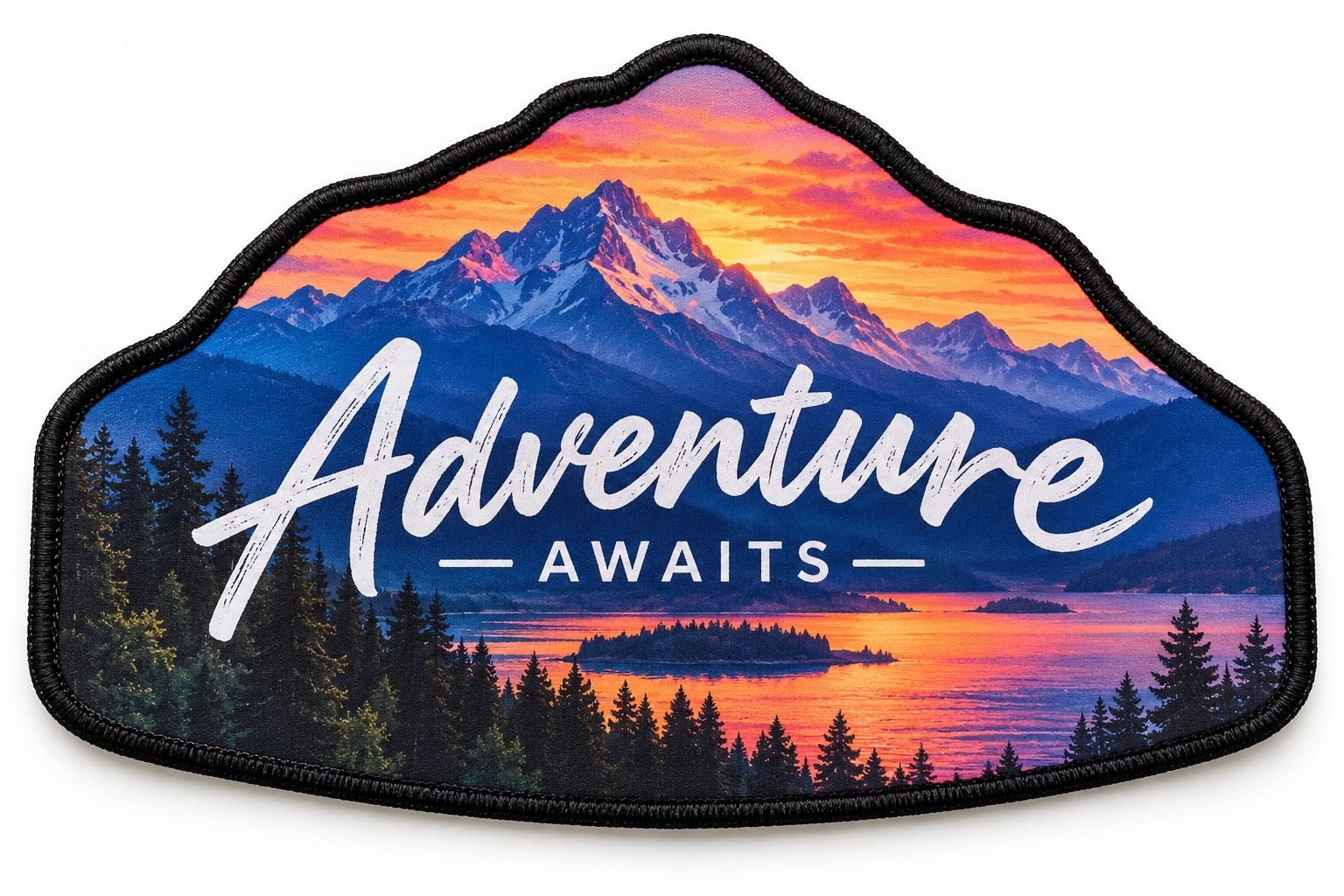
A custom sublimated patch is printed, not stitched. The image is dyed into a white polyester face under heat, then cut and edged like any other patch. It is the only construction with no colour limit at all — and the only one with no texture.
| Price | From $1.25 per piece — full grid on patch pricing |
| Minimum order | 50 pieces |
| Production | 10–12 business days standard, 5–7 rush at no extra charge |
| Shipping | Free and tracked worldwide, usually 3–7 business days in transit |
| Proof | Free digital proof — nothing is made until you approve it |
| Payment | 50% deposit once the proof is approved, 50% before dispatch |
When printing beats stitching
Embroidery prices by stitch count, so a complex design costs more and a photographic one is impossible. Sublimation prices by area, so the artwork can be as complicated as you like for the same money. If your logo has a gradient, a photograph, more than nine colours, or fine tonal shading, this is the construction that will actually reproduce it.
The trade-off is honest and worth stating: a printed patch is flat. It has none of the raised thread that makes an embroidered badge read as substantial across a room, and it feels cheaper in the hand because it is cheaper to make. Printed colour also fades under sustained sun in a way thread does not. For a club badge meant to last a decade on a jacket, embroidery is still the better buy.
How much do custom sublimated patches cost?
Sublimation is a flat rate from $1.25 a piece, because the press does not care how busy the artwork is. There is no coverage uplift and no colour count — the 15% charge that applies to full-coverage embroidery does not exist here.
| Construction | From | Colour limit | Texture |
|---|---|---|---|
| Printed / sublimated | $1.25 | None — photographic | Flat |
| Embroidered | $0.75 | Nine thread colours | Raised stitch |
| Woven | $0.95 | Limited palette, fine detail | Flat weave |
| PVC / rubber | $1.85 | Moulded colour blocks | 2D or 3D relief |
| Leather | $1.95 | Etched, minimal colour | Debossed |
| Chenille | $2.50 | Two or three yarns | Deep pile |
What sublimation suits
- Photographic and illustrated artwork — anything that would need more than nine thread colours to reproduce.
- Gradients and tonal shading — sunsets, skies, airbrush work, soft drop shadows.
- Event and merch runs — where the design changes every season and unit cost matters more than a decade of wear.
- Complex designs at small sizes — printing holds detail that a needle cannot place.
- Full-colour reproductions of an existing logo — no Pantone reduction, no simplification, no compromise conversation.
Where it is the wrong choice: anything that has to survive years of outdoor sun, and anything where the raised feel of thread is part of the point — uniform insignia, club colours, ceremonial work. For those, see the seven constructions compared.
Specification
| Process | Dye-sublimation printed onto a white polyester face, then cut and edged |
| Colour | Unlimited, including gradients and photographic images |
| Edges | Merrowed, hot cut or laser cut |
| Backings | Iron-on, sew-on, hook and loop, peel-n-stick or magnetic |
| Artwork needed | Vector, or raster at 300 dpi at final size |
| Minimum order | 50 pieces per design |
| Standard production | 10–12 business days |
| Rush production | 5–7 business days, at no extra charge |
| Shipping | Free, tracked, worldwide |
Common questions
Is a sublimated patch the same as a printed patch?
In everyday use, yes — both names describe the same product here. Strictly, sublimation is one printing method among several; it dyes the fibre rather than sitting on top of it, which is why the colour does not crack or peel the way a surface print can.
Why is it more expensive than embroidery?
Only at the simple end. A plain two-colour logo is cheaper embroidered, because embroidery prices by stitch count and there are few stitches. A photographic design is cheaper sublimated, because embroidery cannot do it at any price. The crossover is roughly where your design passes nine colours.
Will the print fade?
In a washing machine, no — the dye is in the fibre. In sustained direct sun over years, yes, gradually. A patch on a work jacket will be fine; a patch on something parked outdoors all summer, every summer, will lose saturation before a thread patch would.
Can you combine printing and embroidery?
Yes. A common approach is a sublimated background carrying the detailed artwork with key elements — a name, an outline, a border — embroidered over the top, so the patch keeps some relief. Ask for it on your quote and we will price both parts.
What artwork do you need?
Vector is ideal. Failing that, a raster file at 300 dpi at the size the patch will actually be printed — a 3 inch patch needs roughly 900 pixels across. A logo pulled off a website will not hold up; send the original if you have it.
Get a free quote
Send us your artwork, size and quantity for custom sublimated patches and we will come back with a price and a free digital proof. Nothing goes into production until you approve the proof, and shipping is free worldwide.
Related reading
- Patch types compared — all seven constructions, and where each one fails
- Custom embroidered patches — cheaper for simple artwork, from $0.75
- Custom woven patches — the other flat construction, better for small type
- Borders and edge types — which edge your shape can take
- Thread, twill and materials — what each patch is made from