
Insignia
Documentary reference on what badges mean, how insignia systems are structured, and who is entitled to wear what. Descriptive, not permissive.
Insignia is described here for reference only. Names, emblems and marks belong to the organisations that own them, many are protected by trademark or by statute, and nothing on this site should be read as permission to reproduce, sell or wear them. Where you intend to make or wear a badge, the entitlement question is the organisation’s to answer, not ours.
Insignia is a system, not a collection of pictures
A badge on a uniform is rarely decorative. In almost every organisation that uses insignia, each element on the garment answers a specific question, and the answers are readable in a fixed order: who the wearer belongs to, what they do, what they have qualified in, and what they have taken part in. Once you know which question a badge is answering, an unfamiliar uniform becomes legible even when you do not recognise a single emblem on it.
The categories recur across services, countries and civilian organisations because they solve the same problem:
- Identity. Which nation, service, force, corps or organisation the wearer belongs to. Usually the most prominent and most consistently placed badge.
- Unit. Which formation, station, troop, department or chapter. Often the badge with the richest heraldry, because unit identity is where tradition accumulates.
- Rank or grade. Position in the hierarchy. Almost always structured so it can be read at distance and in poor light.
- Qualification. A skill that was tested — a trade, a rating, a licence, a specialism. These are earned once and generally retained.
- Service or participation. Time served, a deployment, a campaign, an event, a tour. These accumulate.
- Name and identifiers. Nametapes, service branch tapes, call signs, blood-group and allergy markers on operational kit.
Earned, issued, bought — and why the difference matters
Three quite different things get sold under the same word. An earned badge marks something the wearer qualified for or took part in, and it means nothing if it can be bought. An issued badge is supplied by the organisation and is often specified down to the thread colour and the manufacturer. A commercial badge is designed and sold for open sale — morale patches, souvenirs, reproduction and fantasy insignia — and it carries no claim at all.
Reproductions of earned insignia are legal to make and sell in many places and illegal in others, and the line often depends on the specific award rather than on insignia in general. Wearing them in a way that asserts an entitlement you do not have is a separate question again, and in a number of jurisdictions a criminal one. If you are ordering a badge that reproduces a real award, a service emblem or a decoration, ask the awarding organisation before you ask a manufacturer.
Reading heraldry on a unit badge
Unit badges tend to inherit the vocabulary of heraldry, which is why they look designed rather than drawn. A few conventions carry most of the meaning:
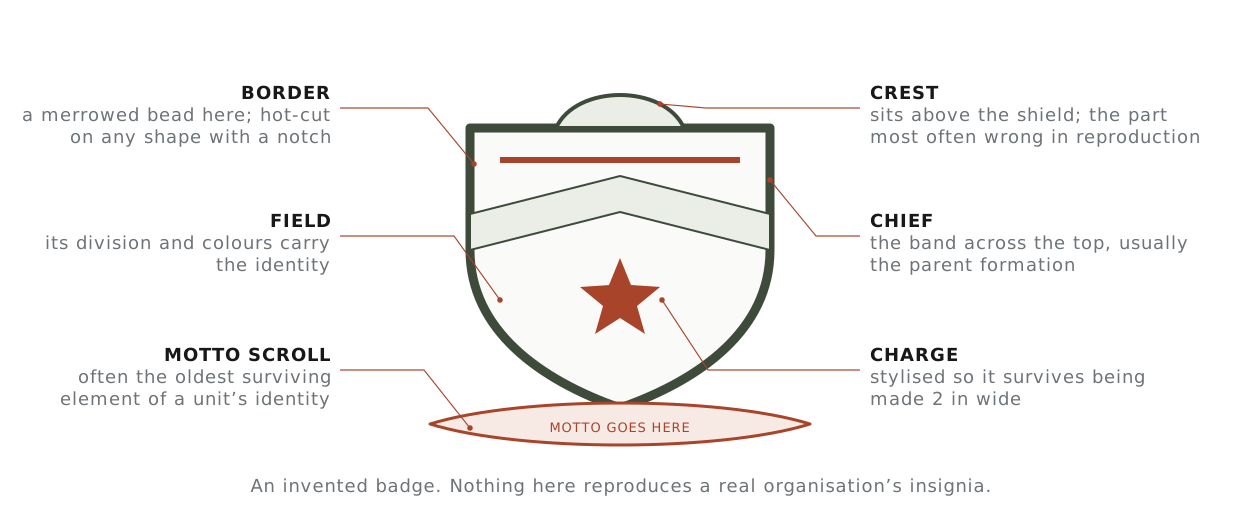
- The shield or field is the ground everything else sits on, and its division and colours usually encode the parent formation.
- Charges — the objects on the field — are chosen to be recognisable in silhouette at small size, which is why they are stylised rather than realistic.
- Tinctures follow a rule of contrast: light colours are not placed directly on light, dark not on dark. A badge that ignores this usually is not from a heraldic tradition.
- The motto scroll carries a phrase that is frequently the oldest surviving element of a unit’s identity.
- Supporters, crowns, wreaths and crests around the shield are the parts most often specified by regulation and most often got wrong in reproduction.
- Facing direction matters. Animals and figures conventionally face the wearer’s right; on a garment this often means the badge is mirrored between the left and right sleeve.
Colour, subdued and infrared
Most operational insignia now exists in more than one version of the same design. Full colour is for dress and ceremonial wear. Subdued versions replace the palette with low-contrast tones matched to the uniform so the badge does not read at distance. Infrared-reflective patches are a third category again, made to a specification about how the material behaves under night-vision equipment rather than how it looks in daylight — which is why they cannot simply be copied by matching the colours.
The practical point for anyone ordering: subdued and IR insignia are specification items, not colourways. A supplier who offers to “match the subdued version” by eye is offering you something that looks similar in a photograph and behaves differently in the field.
Morale patches
Morale patches are the unofficial half of the tradition: humour, in-jokes, unit references and commemorations, usually on hook backing so they can come off before an inspection. They are commercial items and carry no entitlement claim, which is exactly why they are the safest category to design and sell — provided the design does not reproduce a protected emblem, a real award, or a trademark belonging to someone else.
Motorcycle club insignia is the most misread system in this subject: what the patches on a motorcycle vest mean covers the format and separates the documented conventions from the folklore, and which patches to avoid covers the practical side.
Collecting, provenance and reproduction
For collectors, the questions that decide value are construction and provenance rather than design: what the base cloth is, how the edge was finished, whether the backing is period-correct, and whether there is any documentation connecting the badge to a person or unit. Reproduction is a legitimate part of the hobby — re-enactment and museum display depend on it — and the norm that keeps it legitimate is that reproductions are described as reproductions at every point of sale.
Two guides go into this in detail: how to identify and date an old patch, which covers the construction features worth recording, and how to display a patch collection, which covers mounting and storage that will not damage what you have.
What is published here
Insignia guides on this site describe structure, terminology and construction. Where a page states what an organisation requires, it names the publication it took that from and the date the figure was last checked. Where no citation appears, the page is describing a general convention.
Related: placement is where insignia and regulation meet most often, and construction covers the woven, embroidered and PVC methods used to make the badges described here.
Need insignia patches produced to spec?
Send the regulation size and we will digitize, proof and produce them to match — usually embroidered or woven, with a sew-on or Velcro backing.
We make custom military patches, custom police patches and custom fire department patches to order, from 50 pieces with a free proof.